Category: Uncategorized

  • Russia using Interpol’s wanted list to target critics abroad, leak reveals

    Russia using Interpol’s wanted list to target critics abroad, leak reveals


    Cate Brown, Max Hudson and Julia LuftBBC Eye Investigations

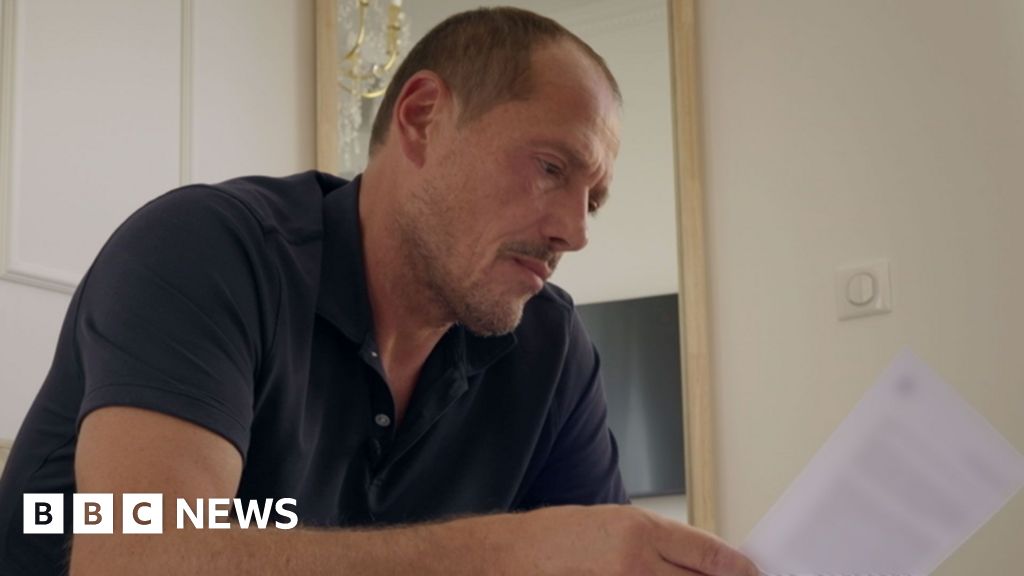
    BBC A man with short, light brown hair and stubble looks at a piece of paper. He is wearing a dark blue, short-sleeved polo shirt. BBC

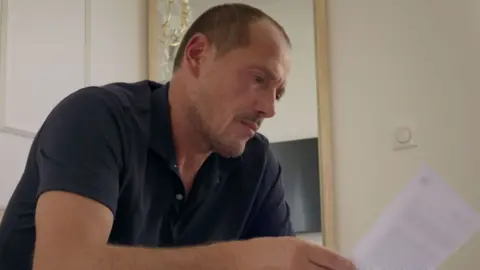
    Businessman Igor Pestrikov found Moscow had put him on a wanted list after he fled Russia in 2022

    Thousands of files provided by a whistleblower at Interpol expose for the first time the extent of Russia’s apparent abuse of the international policing agency to target its critics abroad.

    The data provided to the BBC World Service and French investigative outlet, Disclose, reveals that Russia is using Interpol’s wanted lists to request the arrest of people such as political opponents, businessmen and journalists, claiming that they have committed crimes.

    Analysis of data also suggests that over the past decade, Interpol’s own independent complaints unit has received more complaints about Russia than anyone else – three times more than the next highest country, Turkey.

    In addition, it indicates complaints against Moscow’s requests have led to more cases being overturned than for any other country.

    After Russia’s full-scale invasion of Ukraine, Interpol introduced extra checks on Moscow’s activity “to prevent any potential misuse of Interpol’s channels in relation to the targeting of individuals within or beyond the conflict in Ukraine”.

    But the leaked documents suggest these did not prevent Russia abusing the system and the whistleblower told us some stricter measures were quietly dropped in 2025.
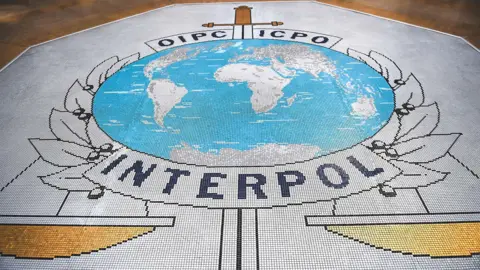
    OLIVIER CHASSIGNOLE/AFP via Getty Images A mosaic on the floor of the Interpol building showing the organisation's logo. It has a map of the world in a circle with the sea depicted in blue and the land in grey. Behind the map is a sword and beneath it are gold weighing scales and the word Interpol.OLIVIER CHASSIGNOLE/AFP via Getty Images

    Interpol says it has systems in place to avoid misuse and these have been strengthened in recent years

    In response, Interpol says that every year, thousands of the world’s most serious criminals are arrested thanks to its operations and that it has a number of systems to avoid misuse which have been strengthened over the last few years.

    It also says it is aware of the potential impact requests for arrest can have on individuals.

    “When you’re hit with a red notice, your life changes completely,” says Igor Pestrikov, a Russian businessman, whose name appears in the leaked files.

    Interpol is not a global police force itself, but helps police across the world to co-operate.

    A red notice is an alert to all of its 196 member countries, asking them to locate and arrest a person. A red diffusion is a similar request but is only sent to individual countries.

    Pestrikov found he was named in a red diffusion after he fled Russia in June 2022 – four months after the invasion of Ukraine – and applied for asylum in France.

    He felt he had two options: “Go to the police and say, ‘I’m in the Interpol system,’” and risk arrest or lie low. This may mean “you can’t rent an apartment, your bank accounts get blocked”, which is what happened to him, he says.

    “It’s constant nerves, all the time,” he adds, explaining he was always looking over his shoulder. For safety, his daughter and her mother moved to another country. The police can “break into your house at any time… that’s why you’re like a cornered rat”, he says.

    “It’s the stress, the nerves, the pressure, the lawlessness inflicted on you,” that breaks families apart, he adds.

    Pestrikov had been a major shareholder in large metals companies in Russia that were privatised in the 1990s, most notably Solikamsk Magnesium Plant.

    In the months leading up to the 2022 invasion of Ukraine, he says government ministers pressured him to stop selling his products abroad and only supply the Russian market. He believed this would mean his products could be used to make components for military hardware, such as fighter jets and tanks.

    He says it wasn’t just that he was against “having to sell much cheaper and to whoever the ministries told me to” but that “it was a moral issue as well… no-one wanted to get involved even indirectly in the production of something used to kill people”.

    Pestrikov believes his refusal to comply and the fact his wife at the time was Ukrainian led to his companies being nationalised and to Russia investigating him for financial crimes.

    After he fled to France, he was worried that the Kremlin might try to target him there, so he contacted Interpol and was told about the red diffusion request, which had passed the agency’s checks.

    Pestrikov decided to challenge it through Interpol’s internal, independent watchdog, the Commission for the Control of Interpol’s Files (CCF), arguing that Russia’s request was politically motivated.

    Interpol’s constitution expressly states that the organisation cannot be used “to undertake any intervention or activities of a political, military, religious or racial character”.
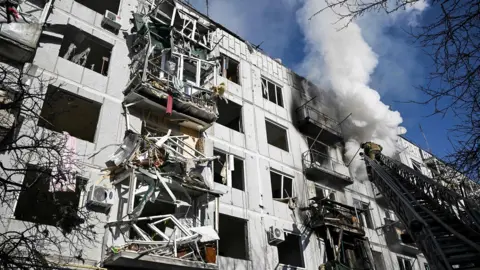
    ARIS MESSINIS/AFP via Getty Images A firefighter is standing on a ladder next to a light grey multi-storey building which has white smoke pouring out of it. The twisted remains of balconies can been seen and there is no glass in many of the window frames. ARIS MESSINIS/AFP via Getty Images

    Pestrikov fled Russia after its full-scale invasion of Ukraine began – one of the first cities to be attacked was Chuguiv in eastern Ukraine

    After Pestrikov had spent almost two years on the wanted list, the CCF ruled that his case was predominantly political. He showed us CCF documents that said the information Russia had provided was “generic and formulaic” and there had been an “inadequate explanation” of the alleged crime. Interpol cancelled the request for Pestrikov’s detention.

    Interpol only releases very basic data about illegitimate requests for arrests and since 2018 has not revealed which countries are the subject of complaints and inquiries. This lack of transparency makes it difficult to assess the scale of the problem, but for the first time, the leaked documents reveal a much fuller picture.

    One batch of files shared with the BBC contains a list of complaints sent to the CCF.

    The data is not complete, but it covers a broad range of countries, and where the nation requesting an arrest is listed, there are more complaints about Russia than anywhere else – this has been the case for the past 11 years.

    The files also show that in the past decade, at least 700 people who were wanted by Russia complained to the CCF, and at least 400 of them had their red notices or diffusions overturned – that is more than for any other country, according to the data we received.
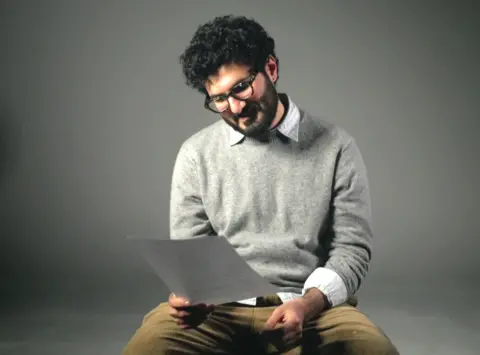
    A man with thick, curly, dark hair, moustache and beard looks at a piece of paper. He is wearing glasses, a light grey jumper over a light shirt, and light brown trousers.

    The files show Russia attempted to use Interpol’s messaging system to get information about journalist Armen Aramyan after he left the country

    “Historically it has been Russia who is one of the main perpetrators of abusive red notices,” says British barrister Ben Keith, who has represented many clients wishing to have their names removed from Interpol’s wanted lists.

    He thinks Interpol has a particular problem with Russia and that the agency’s attempts to prevent abuse have not been successful.

    He says that he has “a steady flow of clients who are subject to Russian red notices who are either politically connected, or often pro-Ukraine, or alternatively as a result of corporate raiding”.

    International lawyer Yuriy Nemets, who specialises in Interpol matters and extradition, agrees that Interpol’s extra scrutiny of Russia’s requests for arrests, introduced after its full-scale invasion of Ukraine, has not proved effective.

    He says he is aware of a number of cases in which Russians opposed to the war “have been targeted for speaking out against what’s going on and were charged with financial… or other ordinary crimes and put into the database based on that”.

    “It’s not hard to game the system,” he adds.

    As well as information on notices and complaints, the Interpol insider also provided the BBC with thousands of messages sent between individual countries via Interpol’s messaging system, revealing another, less formal route to trace people abroad.

    One message from Moscow to law enforcement agents in Abu Dhabi explained how Interpol had denied a request for a red notice, but that it still wanted help in tracing the subject’s whereabouts. This goes against Interpol advice that members should not use its channels in this way.

    The leak also contains a message about Armen Aramyan, a journalist who had fled Russia after he was convicted of “engaging minors in dangerous activities” for reporting on student protests that supported the opposition leader Alexei Navalny in January 2021.
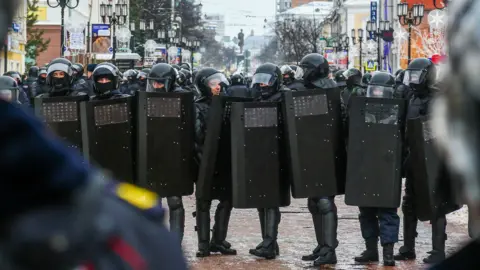
    Aleksey Fokin/SOPA Images/LightRocket via Getty Images A row of police officers, wearing black uniforms with riot shields, helmets and protective leg gear, stretches across a street in a town centre. Aleksey Fokin/SOPA Images/LightRocket via Getty Images

    Riot police were deployed when thousands of people across Russia protested against the arrest of opposition leader Alexei Navalny, who died in suspicious circumstances in prison in 2024

    Aramyan went to Armenia and then on to Germany. The message from Russia to law enforcement entities in both countries sidestepped the more formal red notice and red diffusion process, and asked for “any useful information” about Aramyan as well as his whereabouts.

    The message was sent in February 2023, during the time Russia was under restrictive measures and its messages were being checked before being sent. We can’t say for sure whether the message was delivered, but based on the source of the data, the whistleblower believes that it was.

    When the BBC showed Aramyan a copy of the message, he said he was shocked but not surprised.

    “I don’t think they expected that Germany [would] send them my address, my phone number, and extradite me, but if they could at least get some sort of tiny bits of information it would still be valuable for them.”

    The leak contains other messages in which a foreign law enforcement agency responds to Moscow’s request for information. It sent details about the movements of an ally of Navalny, Lyubov Sobol, and high-profile defector Gleb Karakulov. The exchange relating to Karakulov happened after Interpol announced its additional vetting of Moscow.
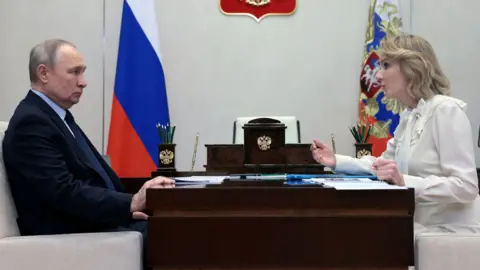
    Sputnik/Mikhail Metzel/Pool via REUTERS Vladimir Putin and Maria Lvova-Belova sit on opposite sides of a desk. He is on the left, looking at her as she speaks. He is wearing a dark suit and tie, she is wearing a white dress. There is a Russian flag in the background. Sputnik/Mikhail Metzel/Pool via REUTERS

    One report says Russia requested red diffusions on ICC judges – this came after the court issued arrest warrants for Vladimir Putin and Russia’s commissioner for children’s rights, Maria Lvova-Belova, over Ukraine

    The BBC also gained access to internal Interpol reports from 2024 and 2025 which show ongoing concern around Russia’s activities from senior directors within the organisation.

    In one, a senior figure expresses directly to Russian delegates “serious concerns” about the country’s “wilful misuse” of Interpol systems, stating that there were instances of “flagrant violations” of Interpol rules.

    Despite the extra restrictions on Russia, the reports show that approximately 90% of Russia’s requests were still passing initial checks in 2024. And yet, in the same period, the CCF was overturning roughly half of all Russian requests that it received complaints about. This raises questions about whether the measures had been stringent enough.

    One report describes how in 2024 Russia attempted to place red diffusions on judges and a prosecutor at the International Criminal Court, after the body issued arrest warrants for President Vladimir Putin and another government official for their actions in Ukraine. These requests from Moscow were rejected.

    Even while concerns about Russia’s misuse of Interpol’s systems were being expressed inside the organisation, the reports also show that discussions were taking place in 2024 and 2025 about whether to remove additional restrictions on Russian activity.

    This seems to have been settled in Moscow’s favour. The whistleblower told the BBC that in 2025 Interpol quietly dropped some extra measures against Russia — it is not clear how far this softening may have gone. Despite repeated requests, Interpol said it was not able to comment due to its “strict rules on the processing of data”.

    The BBC was unable to disclose all the details of the leak to Interpol as doing so could reveal the source. However, when asked about the issues raised in the investigation, Interpol said it was “concerned that a number of the accusations seems to come from a misunderstanding of how Interpol and CCF systems work, or factual errors about data and changes within Interpol’s systems”.

    “It is untrue to say that we prioritise police co-operation over preventing abuse – Interpol follows its constitution that expressly forbids the use of our systems on information that is of a predominantly political, military, religious or racial character.”

    And in the past, it has said it can do more good to prevent crimes by ensuring that lines of communication remain open.

    We asked Russia’s ministry of internal affairs for comment, but it did not respond.

    Lawyers Yuriy Nemets and Ben Keith agree that Interpol should do more to prevent misuse of its systems. “If countries are found to be significantly and persistently abusing red notices and diffusions, then they should be suspended from the system for a period of time,” says Keith.

    Otherwise, Igor Pestrikov fears that Russia, “with the push of a button, can enter anything, pin any crime on you – this lets them persecute you further around the world”.

    Additional reporting: Andreea Jitaru and Ned Davies


    Source link

  • Trump, unbowed by backlash to Minneapolis shooting, blames Democrats for ‘chaos’

    Trump, unbowed by backlash to Minneapolis shooting, blames Democrats for ‘chaos’


    WASHINGTON (AP) — The fatal shooting of a Minneapolis protester by a federal immigration officer touched off a fierce national debate and prompted some fellow Republicans to question President Donald Trump’s hard-line immigration crackdown, but the president on Sunday night continued to blame Democratic officials.

    After remaining relatively quiet on Sunday, the Republican president in two lengthy social media posts said that Democrats had encouraged people to obstruct law enforcement operations. He also called on officials in Minnesota to work with immigration officers and “turn over” people who were in the U.S. illegally.

    “Tragically, two American Citizens have lost their lives as a result of this Democrat ensued chaos,” Trump wrote on his Truth Social media network.

    Trump’s refusal to back away from his pledge to carry out the largest deportation program in history and the surge of immigration officers to heavily Democratic cities came as more Republicans began calling for a deeper investigation and expressing unease with some of the administration’s tactics.

    Trump also told The Wall Street Journal in an interview Sunday that his administration was “reviewing everything,” but he refused to say whether the officer who shot 37-year-old Alex Pretti acted appropriately.

    “We’re looking, we’re reviewing everything and will come out with a determination,” Trump said.

    The White House did not answer questions about whether Trump watched the videos of the shooting in Minnesota, which seemed to contradict the account of what happened by members of his administration, or whether he planned to speak to Minnesota’s Democratic Gov. Tim Walz, who had appealed to the president to help bring calm to the city.

    Instead, Trump on Sunday night said he would call on Congress to pass legislation banning so-called sanctuary cities. His administration has sought to apply the label to communities based on their cooperation with federal immigration enforcement efforts, among other factors.

    His push for action by lawmakers comes even as outrage over the shooting has raised the possibility of a partial government shutdown in a week because of a standoff over additional funding for immigration enforcement.

    Trump’s initial reaction to the shooting of Pretti came hours after it took place on Saturday. In a post on his Truth Social network, he questioned why Pretti had a firearm and accused Walz and Minneapolis Mayor Jacob Frey of inciting “Insurrection, with their pompous, dangerous, and arrogant rhetoric.”

    But throughout the weekend, Trump, who rarely lets a major moment go without comment, did not make any public appearances or express any dismay over Pretti’s death.

    Instead, he posted online complaining about Canada and efforts to stop him from building an expansive ballroom at the White House, calling a lawsuit to block its construction “devastating to the White House, our Country, and all concerned.”

    He also posted messages praising U.K. troops after his comments about them earlier in the week were widely interpreted as a grave insult and praising guests appearing on Fox News Channel.

    When he finally weighed in again Sunday night as criticism grew, Trump was unbowed.

    He called on Walz and Frey, also a Democrat, to turn over for deportation anyone in the country illegally who was held in state prisons or local jails, along with anyone who has a warrant out for their arrest or a criminal history.

    In his comments to The Wall Street Journal, Trump criticized Pretti for carrying a gun.

    “I don’t like any shooting. I don’t like it,” Trump said. “But I don’t like it when somebody goes into a protest and he’s got a very powerful, fully loaded gun with two magazines loaded up with bullets also. That doesn’t play good either.”

    He said that immigration enforcement officers will leave Minneapolis “at some point” but did not offer a time frame.

    Members of his administration, meanwhile, were quick to say the shooting, the second killing of a U.S. citizen in Minneapolis by immigration officers in recent weeks, was a case of an armed man provoking violence.

    Deputy White House chief of staff Stephen Miller said in a post on social media, without offering any evidence, that Pretti was “an assassin” who “tried to murder federal agents.”

    Vice President JD Vance shared Miller’s post. He issued other ones blaming local officials and describing what was happening in Minneapolis as “engineered chaos” that was “the direct consequence of far left agitators, working with local authorities.”


    Source link

  • ‘Worst in living memory’ say those rescued from rising waters

    ‘Worst in living memory’ say those rescued from rising waters


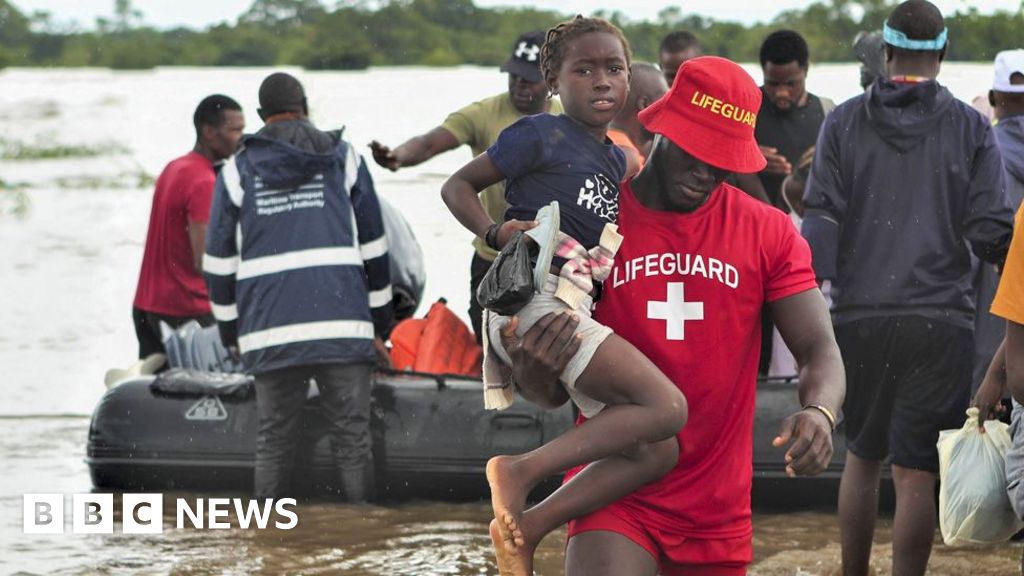
    EPA/Shutterstock A man in a red T-shirt and hat with the word 'Lifeguard' on helps a girl through flood waters in southern Mozambique. Behind them is a rubber speed boat with men around it.EPA/Shutterstock

    Tens of thousands of people in Mozambique are being rescued as rising waters continue to devastate the southern African nation – the worst flooding in a generation.

    Teams from Brazil, South Africa and the UK have been helping with life-saving rescue operations.

    “For me, this is the first time I have experienced a calamity of this magnitude. Elders say a similar disaster took place in the 1990s,” 24-year-old mechanic Tomaz Antonio Mlau says.

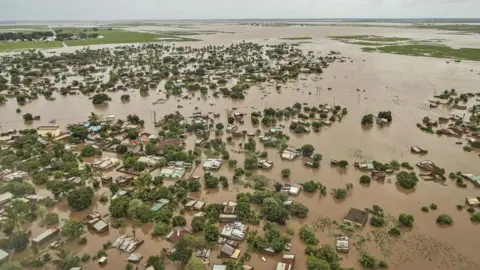
    EPA/Shutterstock An aerial view showing flooded neighbourhoods and brown water stretching out into the distanceEPA/Shutterstock

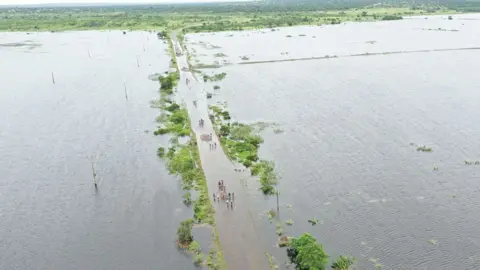
    Many areas of south and central Mozambique are under water after two weeks of continuous downpours

    Mlau and his family, who live near Marracuene – a town 30km (19 miles) north of the capital, Maputo – woke up to find their house inundated after the Inkomati River burst its banks.

    “When a rescue boat came a few hours afterwards, we did not hesitate to board it and come to safety in Marracuene town,” he said, adding they had to abandon all their belongings and only managed to bring a change of clothes.

    Mlau, his wife and two children have found refuge at one of six centres – schools and churches – that are so far sheltering about 4,000 people.

    Many of those gathered at Gwazamutini Secondary School are farmers from the low-lying areas with livestock and rice fields.

    “We lost everything in the floodwaters, including houses, TV sets, fridges, clothing and livestock – cattle, goats and pigs. Our farms are under water. I am a farmer. I grow quality rice,” 67-year-old Francisco Fernando Chivindzi told me.

    His home is in Hobjana, one of several flooded neighbourhoods between the left bank of the Incomati River and the coastal tourism resort of Macaneta. Marracuene town is on the river’s right bank.

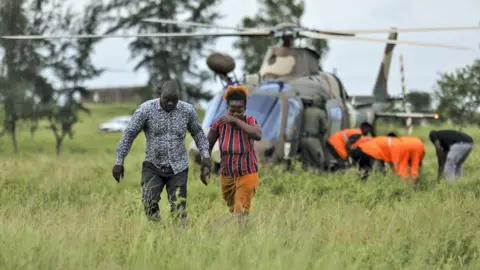
    EPA/Shutterstock A man and a women walk away from a military helicopter as members of a rescue teams in orange coats help someone in a stretcher in MozambiqueEPA/Shutterstock

    More than 650,000 people have been affected by the rising water

    “The floodwaters reached heights we weren’t expecting. We have never experienced this level of flooding in my lifetime,” Chivindzi said.

    “We are happy to be here on higher ground. However, we are very worried that all our belongings were left behind.”

    The farmer expressed his gratitude to the boat owners who came to assist him and his neighbours free of charge – and he urged others to save themselves.

    “We hear that there are still some people resisting – clinging to treetops and on roofs. I wish they would heed the rescuers and join us here in this temporary shelter. We should value life more than the goods,” the father of nine said.

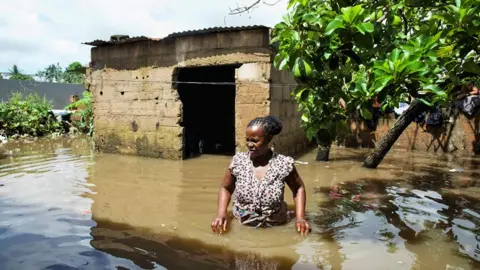
    Reuters A woman standing with water up to her waist with a flooded building and tree behind her.Reuters

    Some people are reluctant to leave their property even though the water is continuing to rise

    This was a view echoed by Shafee Sidat, the mayor of the Marracuene municipality, as he visited Gwazamutini Secondary School on Saturday.

    “We still have people to rescue, some of whom refuse to abandon the risk areas. That’s a challenge. We reckon that more than 10,000 people are affected in Marracuene as a whole,” he told me.

    At least 642,122 people have been affected since 7 January by flooding – particularly in southern and central regions, with 12 deaths recorded so far, according to provisional data from the National Institute for Disaster Risk Management and Reduction.

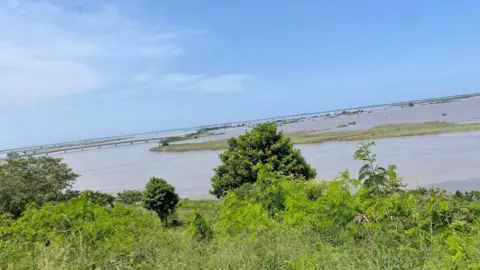
    Jose Tembe/BBC Flooded landscape by the Inkomati River with a bridge in the distanceJose Tembe/BBC

    The worry is that Inkomati River will be deluged with more waters released from a dam in South Africa

    In total 125 people have died in Mozambique since the rainy season began in October.

    Mayor Sidat fears the situation is likely to get worse because of heavy rain in neighbouring South Africa, the source of the Inkomati River.

    “We are worried about discharges of a South African dam on the Inkomati River. Our town is the last one downstream,” the mayor said.

    “Before the waters flow into the Indian Ocean, they flood the ‘machambas’ (farmlands), homes and grazing areas here in the low-lying zones.”

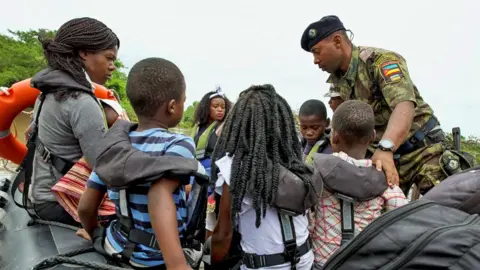
    Reuters A soldier helps seat women and children wearing life jackets on a rubber speedboatReuters

    The military has been overseeing rescue efforts

    Some aerial views show water as far as the eye can see. Hundreds of families remain cut off.

    All vehicles have now been banned from roads between the provinces of Maputo and Gaza to the north.

    AFP/Getty Images Aerial view showing people residents wading through floodwater to cross a road near Maputo on January 20, 2026.AFP/Getty Images

    Main roads have been cut off in the south of the country

    Transport Minister João Matlombe said it was because main roads, in particular the N1 highway which runs the whole length of the country and is the only link to the north, were flooded.

    The suspension is already leading to shortages and price hikes, including of basic foodstuffs, coconut and fuel – even as far away as the north-western city of Tete, more than 1,500km from Maputo.

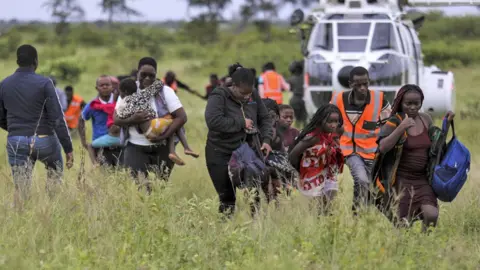
    EPA/Shutterstock A group of people, including people holding children, leave a white helicopter that has landed in a field in Mozambique.EPA/Shutterstock

    Many of those rescued have only only been able to bring a small bag of belongings with them

    For those at shelters in Marracuene, food is also a challenge.

    “There isn’t yet enough food to eat,” said Aninha Vicente Mivinga, whose two children are aged two and five.

    “On the first day this Friday, there was almost nothing to eat. It was painful to see children sleeping without anything to eat, except biscuits. Today things improved,” she said.

    Mivinga, who is a police officer and farms in her spare time, described how she was at work in Marracuene town when the floods hit at her home in Hobjana.

    The 32-year-old had taken the precaution of taking her children to stay with family members who lived on higher ground because of the continuous rain, but even they were affected by the rising waters.

    “To learn that my children and other members of the family were on floodwaters and at risk of dying was horrific. I was devastated and completely shaken,” the officer said.

    “Eventually my relatives were brought to safety.

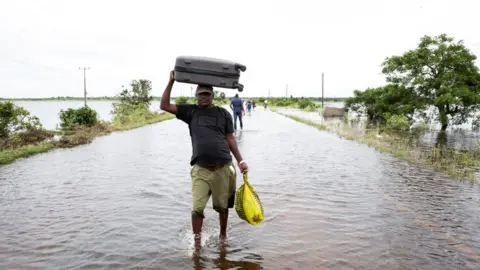
    Reuters A man walks along a flooded road with a suitcase on his headReuters

    Some people are not sure whether to return to their homes when the waters subside

    “It is the first time since I was born that we’ve been affected by flooding of this dimension.”

    Mivinga said that students were meant to resume classes soon – and she would like the authorities to find permanent alternative accommodation for them.

    Hundreds of people are currently camping down in the classrooms using a traditional wrap cloth as bedding on which to lie down.

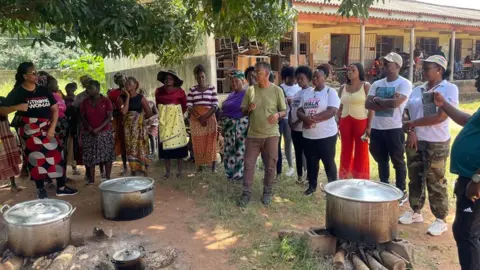
    Jose Tembe/BBC  Shafee Sidat, the mayor of the Marracuene, talks to a group sheltering at a school with cooking pots set up over logs under trees Jose Tembe/BBC

    Mayor Shafee Sidat, in a green T-shirt, visited Gwazamutini Secondary School on Saturday to oversee aid efforts

    “When floodwaters subside, I believe everyone would love to go back home, but it’s too risky. If only the authorities could give us another place on safer ground. We would go back to the risky area only for farming purposes but live on safer ground,” the police officer said.

    Education Minister Samaria Tovela has already hinted that the cabinet is to consider rescheduling the start of the 2026 academic year, originally planned to begin next week, “to allow flood victims to continue using them as accommodation centres, especially in the provinces of Maputo and Gaza, the most affected at the moment”.

    EPA/Shutterstock A large house in Maptuo with flood water seen coming half way up to the windows - with trees behind the building.EPA/Shutterstock

    Areas of the capital, Maputo, are also under water

    Chivindzi, who is not sure that the floodwaters will recede before schools resume, is determined to return home.

    “We’ll restart life from scratch,” the farmer says.

    Mlau, who is unable to get to the garage where he works, is less sure of the future and the risks of starting again in the same place.

    “Even if waters subside, I am not sure I’ll go back there.”

    You may also be interested in:

    Getty Images/BBC A woman looking at her mobile phone and the graphic BBC News AfricaGetty Images/BBC


    Source link