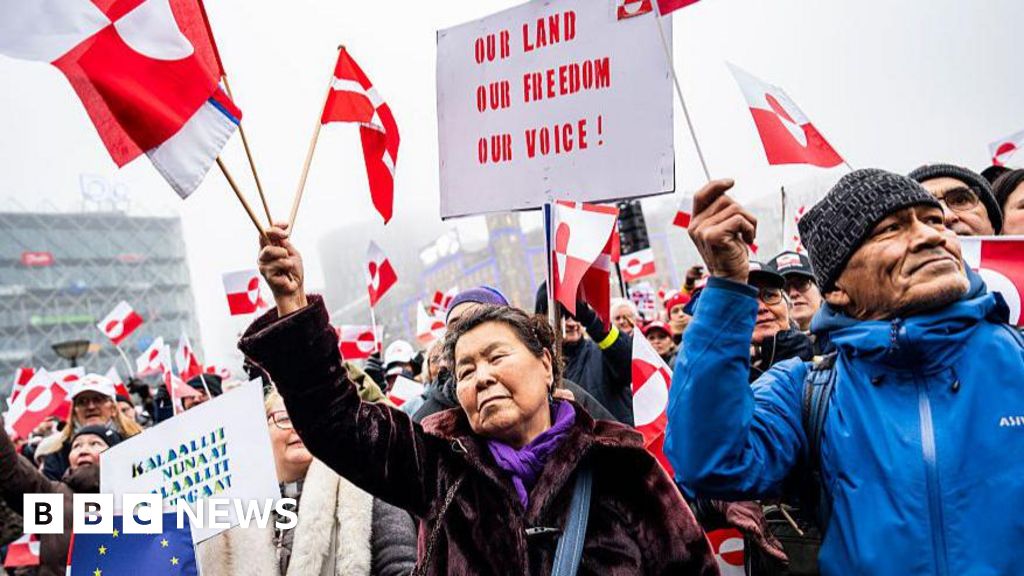
US President Donald Trump’s apparently coercive threat to force Western allies not to oppose his proposed annexation of Greenland, or face further damage to their trade with the US, is without both parallel and precedent.
We’ve had some unusual and unexpected economic threats from President Trump over the past year, but I think it is safe to say this exceeds all of them, and takes us into both surreal and utterly dangerous territory.
If taken at face value, it is a form of economic war being levied by the White House on its closest allies.
That’s because it targets allies at incredibly short notice and for a cause that essentially could break up Nato and the western alliance.
This will be leaving officials from those countries absolutely baffled. In fact, it’s so outlandish that they may indeed be more baffled than angry.
Nobody in the world would assume that a threat like this – based on acquiring the land of your ally – would ever actually happen. Does Trump really have the backing in the US, in Congress, even in his own administration to do this?
Is this, as some trade officials have to assume, the biggest TACO (Trump will Chicken Out) of all time? These things can come and go and, economically, these countries have handled the damage so far.
Greenland: ‘Diplomatic channels are the way to go’, US speaker tells BBC
Think of Canada. It has seen its trade with the US slump. But its prime minister Mark Carney’s strategy has seen Canada’s trade surge with the rest of the world by 14% – which amazingly is worth more than was needed to cover its trade lost with the US.
Carney has been in China this week pushing “a new world order” and pursuing more trade with China, not the detachment sought by some US administration officials.
“This is China versus the world,” the Trump administration was trying to persuade the rest of the world just three months ago.
Carney is showing up this approach, something which is perhaps notable background context for the timing of today’s intervention.
If, however, we do take Trump’s latest threats seriously, they are extremely troubling.
Not so much because of the 10% tariff, but because of its rationale – taking land from an ally, and the act of publicly trying to coerce your allies. How would the world react if China or Russia had sent a threat like this to some of their allies?
The basis of the threat is clearly deeply worrying.
Many in capitals around the world will read Trump’s social media announcement and question the functioning of American decision making.
President Trump arrives to meet leaders of the allied countries whose economies he has just threatened at the World Economic Forum on Wednesday.
Most of the world will hope that, by that time, this unparalleled threat will have somehow disappeared.
The Hacker NewsJan 16, 2026Privacy / Data Protection
You lock your doors at night. You avoid sketchy phone calls. You’re careful about what you post on social media.
But what about the information about you that’s already out there—without your permission?
Your name. Home address. Phone number. Past jobs. Family members. Old usernames.
It’s all still online, and it’s a lot easier to find than you think.
The hidden safety threat lurking online
Most people don’t realize how much of their personal life is sitting on public websites, data broker platforms, and sketchy directories.
These sites don’t just sell your info to marketers—they make it available to anyone with internet access.
And that’s when things can get dangerous. Exposed personal information can lead to:
Doxxing incidents where personal info is leaked online
Harassment that moves from your inbox to your doorstep
Stalkers and scammers are building a profile on you using old addresses and phone numbers
Strangers showing up where you live or work.
It’s not just creepy—it’s a real safety threat.
The real risk of leaving your info unprotected
When your personal details are accessible to everyone online:
You’re easier to target for scams
You’re vulnerable to identity theft
Your physical safety is compromised.
No one should have to worry about who might be watching them online or where that information might lead.
How to stay safe online and offline
The best defense is to delete your personal info from every sketchy site. You can do it manually by Googling yourself, sending out opt-out requests, and continuously hunting down data brokers.
It’ll take you days, if not weeks. That’s where a data removal tool like Incogni comes in. Incogni tracks down your personal data across the internet and forces companies to delete it on your behalf.
They don’t just clean up the obvious data broker sites—they remove your details from:
People search sites
Public, non-governmental directories
Sketchy websites distribute your information for profit.
And with their Unlimited plan, you can send custom removal requests if you find your information exposed somewhere they don’t already cover automatically. Send them the link, and their team will take care of it.
Real people, real protection
Thousands of people trust Incogni to help them feel safer online.
Because personal safety isn’t just about antivirus software or strong passwords—it’s about keeping your private life truly private.
When no one can easily find your home address or phone number, you’re a lot harder to harass, stalk, or scam.
Privacy equals security.
Final thoughts
You deserve to feel safe online and off. Start protecting your personal safety where it matters most—by removing the personal information that puts you at risk.
Because no one should feel unsafe in their own home because of what’s online.
Found this article interesting? This article is a contributed piece from one of our valued partners. Follow us on Google News, Twitter and LinkedIn to read more exclusive content we post.
Israel has moved the blocks which are supposed to mark its post-ceasefire line of control deeper into Gaza in several places, sowing confusion among Palestinians.
Satellite images reviewed by BBC Verify show that in at least three areas Israel placed blocks, before returning later and moving the positions further into the Strip.
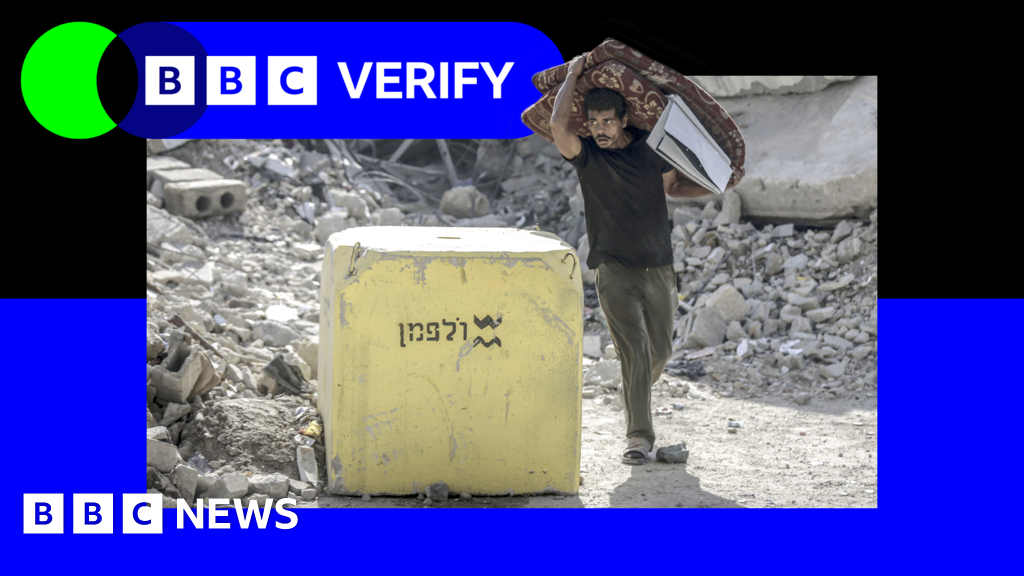
Under the terms of the US-brokered deal with Hamas, Israel agreed to withdraw troops beyond a line marked in yellow on Israeli military maps, which it has illustrated on the ground with concrete yellow blocks.
Defence Minister Israel Katz warned in October that anyone crossing the Yellow Line would be “met with fire”.
Since these comments were made, there have been a series of deadly incidents around the line.
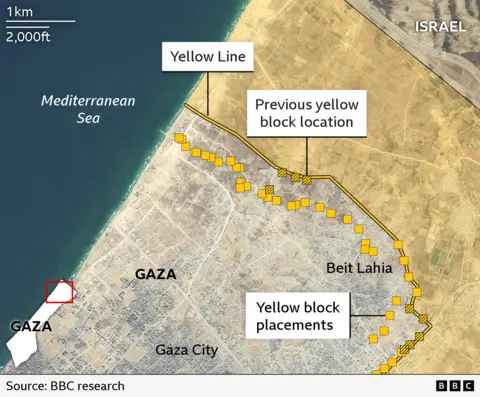
In Beit Lahia, Jabalia and al-Tuffah, the Israel Defense Forces (IDF) placed blocks and later returned to move them deeper inside Gaza. In total, 16 positions were moved.
In the al-Tuffah neighbourhood of Gaza City, satellite images show that IDF troops moved at least seven already placed blocks between 27 November and 25 December.
The position of the markers were moved on average 295m (968ft) deeper inside the Strip.
As well as the blocks that have been moved, BBC Verify mapped 205 other markers. More than half of those have been placed significantly deeper inside the Strip than the line marked on maps.
An IDF spokesperson said it rejected “all claims that the Yellow Line has been moved or its crossing by IDF troops”.
“The IDF is operating to visually mark the Yellow Line in accordance with the conditions on the ground and the ongoing operational situational assessment,” they added.
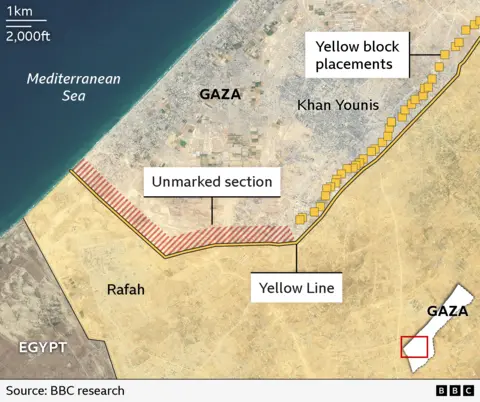
Analysis of satellite images up to 11 January suggests some sections of the Yellow Line – which the head of Israel’s military described as a “new border line” – also remain unmarked on the ground more than three months since the ceasefire began.
The latest satellite images reviewed by BBC Verify show that blocks have not been placed along roughly 10km (six miles) of territory – leaving some people in Gaza struggling to know where the beginning of what the IDF calls a “dangerous combat zone” is.
Last month, one 23-year-old man near Khan Younis – whom the BBC is not naming for his own safety – said Israeli troops suddenly moved blocks near him beyond the mapped line, leaving him “trapped”.
“We are now living inside the Yellow Line, [but] behind the yellow blocks, with no idea what our fate will be,” he said. “The atmosphere at night is terrifying. We hear shells exploding, soldiers advancing, gunfire, and drones buzzing overhead without pause. We are also being shot at directly.”
Prof Andreas Krieg, a Middle East security expert from King’s College London, has called the movement of the blocks a “tool for territorial engineering”.
“By keeping the legal line on the map and the physical blocks hundreds of metres apart, Israel preserves the ability to shift where Gazans may live, move and farm without ever formally announcing a change of border,” he said.
But Efraim Inbar – president of the Jerusalem Institute for Strategy and Security – suggested that the mapped line may not account for natural barriers to the markers and that IDF engineers may be putting the blocks where they “find it easier to place”.
Series of deadly incidents around the Yellow Line
Since Katz’s warning in October, troops have shot at people crossing the Yellow Line on at least 69 occasions, an analysis of IDF Telegram posts and statements to the BBC showed.
On 19 December, the IDF conducted a strike on a school sheltering displaced people in the al-Tuffah neighbourhood of Gaza City – some 330m inside the Palestinian side of the line, according to the IDF maps – but just metres from a yellow block that was moved there.
Eyewitnesses said it happened while a wedding was taking place right by the school building. Five people, including children, were killed in the blast, Gaza’s Hamas-run Civil Defence agency said.
An IDF statement relating to that day said they fired at “suspicious individuals” west of the Yellow Line, adding that the incident remained under review and that it “regrets any harm to uninvolved individuals”.
In another deadly incident, 17-year-old Zaher Nasser Shamiya was killed near yellow blocks in Jabalia camp in northern Gaza. His father said IDF troops fired at him before running him over with a tank on 10 December.
“The tank turned his body into pieces… it came into the safe area [west of the Yellow Line] and ran over him,” he said. BBC Verify has approached the IDF for comment on the incident.
And in November, local media reported that two children – aged eight and 10 or 11 – were killed by Israeli forces. Their uncle said that the pair had been gathering firewood for their disabled father when they were killed.
Addressing the deaths, an IDF statement said it had eliminated two suspects who crossed the Yellow Line, conducted suspicious activities on the ground, and approached IDF troops. It did not offer details on how the pair were identified as suspects.
An IDF spokesperson accused Hamas fighters of firing on troops six times “beyond the Yellow Line” over the past week, in a statement to BBC Verify.
Demolitions and fortification
While Israel agreed to withdraw its forces behind the Yellow Line under October’s ceasefire deal, videos and satellite images seen by BBC Verify have repeatedly shown IDF vehicles operating beyond the mapped Yellow Line.
In verified clips, armoured personnel carriers and bulldozers were seen 400m past the mapped Yellow Line at the Bani Suhaila roundabout in Khan Younis, while a satellite image taken on 25 December appeared to show a tank, excavator and other IDF vehicles positioned about 260m beyond the Yellow Line in Beit Lahia.
In some cases, the movements of blocks were followed by demolitions of nearby buildings by the IDF.
In the eastern part of Gaza City, satellite images show that hundreds of buildings were levelled up to and even beyond the first position of the blocks, then the markers were moved and there was further destruction
In the nearby area of Jabalia, Israeli troops demolished a series of school buildings that were around 150m inside the mapped line.
In some instances where IDF demolitions have occurred, the debris has effectively hidden the markers from Palestinians on the ground.
An IDF spokesperson said that troops were dismantling Hamas’ tunnel network that it said runs under buildings on both sides of the Yellow Line, adding that the tunnels’ destruction “may cause the collapse of buildings on both sides of the line”.
On Wednesday, the US said the second phase of the ceasefire deal is due to begin, under which Israel is expected to withdraw from additional parts of the Strip. But there was no mention of a timeline for the withdrawal, which is linked to the “demilitarisation” of Hamas under October’s ceasefire deal.
In parts of the Strip, the markers have been placed shortly before work began on the construction of temporary Israeli fortifications such as roadblocks and defensive barriers beyond the mapped Yellow Line.
Krieg told BBC Verify that the movement of the blocks would eventually allow Israel to turn parts of Gaza into a “sterilised belt”.
“In practice, that means the status of land is less about what the ceasefire map says and more about where concrete blocks sit on a given day,” he said.

 Getty Images