Category: Uncategorized

  • Trump tariff threat over Greenland ‘unacceptable’, European leaders say

    Trump tariff threat over Greenland ‘unacceptable’, European leaders say


    Henri Astierand

    Bernd Debusmann Jr,White House reporter

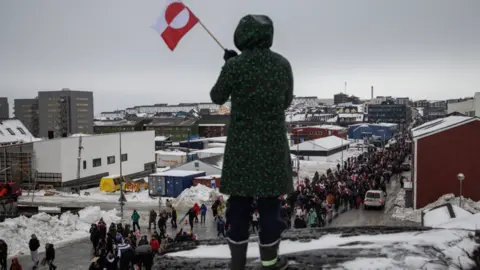
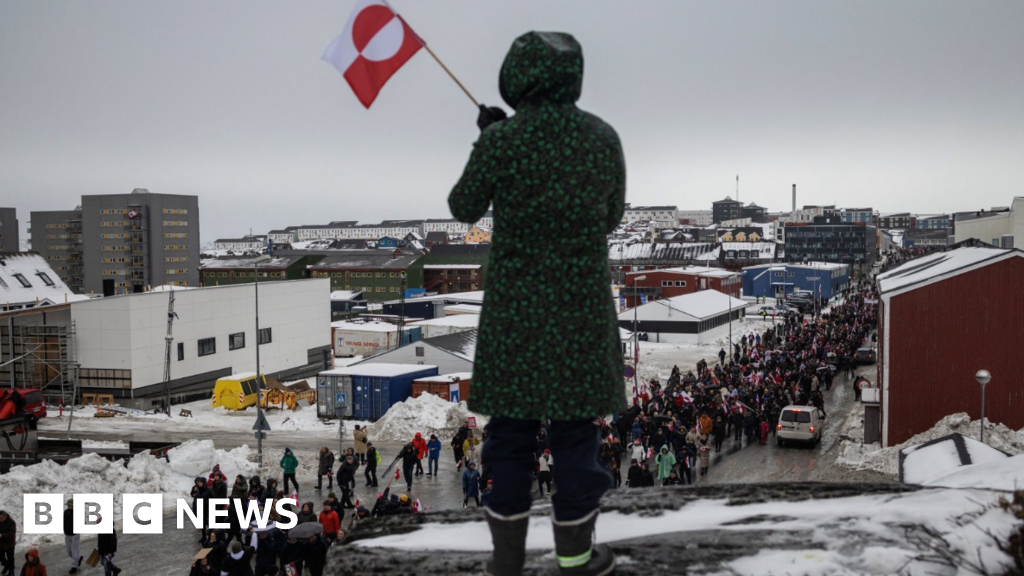
    Reuters A woman waves a Greenlandic flag as people attend a protest against President Donald Trump's demand that the Arctic island be ceded to the US, in Nuuk, the capital of GreenlandReuters

    Protesters in Greenland rallied on Saturday against any US move acquire the territory

    A threat by President Donald Trump to impose fresh tariffs on eight allies opposed to his proposed takeover of Greenland has drawn condemnation from European leaders.

    UK Prime Minister Keir Starmer said the move was “completely wrong”, while French President Emmanuel Macron called it “unacceptable”.

    The comments came after Trump announced a 10% tariff on goods from Denmark, Norway, Sweden, France, Germany, the UK, the Netherlands and Finland would come into force on 1 February but could later rise to 25% – and would last until a deal was reached.

    Mr Trump insists the autonomous Danish territory is critical for US security and has not ruled out taking it by force.

    Meanwhile, thousands of people took to the streets in Greenland and Denmark on Saturday in protest at the proposed US takeover.

    Greenland is sparsely populated but resource-rich and its location between North America and the Arctic makes it well placed for early warning systems in the event of missile attacks and for monitoring vessels in the region.

    Trump has previously said Washington would get the territory “the easy way” or “the hard way”.

    Greenland: ‘Diplomatic channels are the way to go’ US speaker tells BBC before tariff announcement

    European countries have rallied to Denmark’s support. They have argued that the security of the Arctic region should be a joint Nato responsibility.

    France, Germany, Sweden, Norway, Finland, the Netherlands and the UK have dispatched a small number of troops to Greenland in a so-called reconnaissance mission.

    Announcing the new tariffs in a post on his Truth Social platform on Saturday, Trump said those countries were playing “a very dangerous game”. At stake, he said, was the “Safety, Security, and Survival of our Planet”.

    He said the proposed 10% levy to be introduced next month on goods exported to the US would rise to 25% in June and remain “payable until such time as a Deal is reached for the Complete and Total purchase of Greenland”.

    In his response, Starmer said: “Applying tariffs on allies for pursuing the collective security of Nato allies is completely wrong. We will of course be pursuing this directly with the US administration.”

    France’s Emmanuel Macron said: “Tariff threats are unacceptable in this context… We will not be swayed by any intimidation.”

    Swedish PM Ulf Kristersson said: We won’t let ourselves be blackmailed.”

    “Sweden is currently having intensive discussions with other EU countries, Norway and the United Kingdom to find a joint response,” he added.

    European Council President Antonio Costa stated: “The European Union will always be very firm in defending international law… which of course begins within the territory of the member states of the European Union.”

    Denmark’s foreign minister Lars Lokke Rasmussen said the threat had “come as a surprise”.

    Meanwhile, German MEP Manfred Weber, head of the conservative EPP group in the European Parliament, said Trump’s move raised questions about the still-to-be-ratified EU-US trade deal negotiated last year.

    Brussels and Washington clinched a deal that agreed a US tariff on all EU goods of 15% and that the 27-member bloc would open its markets to US exporters with 0% tariffs on certain products.

    “The EPP is in favour of the EU-US trade deal, but given Donald Trump’s threats regarding Greenland, approval is not possible at this stage,” Weber posted on X. “The 0% tariffs on US products must be put on hold,” he added.
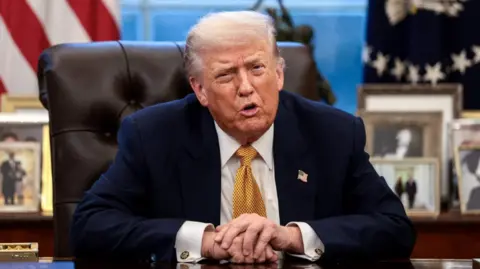
    Reuters Trump at his Oval Office desk Reuters

    Trump has recently escalated his drive to acquire Greenland

    The US ambassador to the UN, Mike Waltz, however, said Denmark “just doesn’t have the resources or the capacity to do what needs to be done in the northern region”.

    He told Fox News the life of Greenlanders would be “safer, stronger and more prosperous under the umbrella of the United States”.

    Trump has often mused that “tariff” is his favourite word, and he has made clear that he views it as something of a blunt instrument with which to convince – or coerce – countries around the world to align their policies with the desired outcomes of the White House.

    But his announcement represents a significant escalation in his recently rekindled drive to acquire Greenland, despite their opposition.

    It is unclear what immediately prompted the tariffs announcement, which Trump first hinted at while speaking to reporters at the White House on Friday.

    While in recent weeks he has repeatedly said that a variety of options – including the potential use of military force – remained on the table, the announcement comes just days after US and Danish officials agreed to set up a high-level working group to discuss the future of the island.

    In Washington’s diplomatic and political circles, that announcement was seen by many as a “best-case” scenario for Denmark and its European allies – one that would, at the very least, delay any decision or further escalation from the White House.

    Instead, the latest tariffs have injected a newfound sense of urgency into the issue and strained relations with important Nato allies and trading partners.
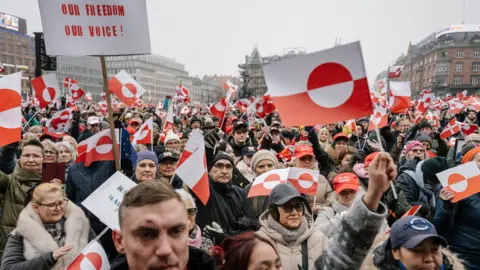
    EPA Protesters waving Greenland's white and red flag in support of self-determination in Copenhagen, 17 January 2016EPA

    Protesters in Copenhagen waved Greenland’s white and red flag in support of self-determination

    Opinion polls suggest 85% of Greenlanders oppose the territory joining the US.

    Demonstrations against Trump’s takeover plans were held in Danish cities as well as in Greenland’s capital, Nuuk, on Saturday – before the tariff announcement.

    In the Danish capital, Copenhagen, placards were held up reading: “Hands Off Greenland” and “Greenland for Greenlanders”.

    “We demand respect for the Danish Realm and for Greenland’s right to self-determination,” said Camilla Siezing, heads of Inuit, an umbrella group of Greenlandic associations.

    In Nuuk, Greenland’s Prime Minister Jens-Frederik Nielsen joined protesters holding signs reading “Greenland is not for sale” and “we shape our future” as they headed for the US consulate.

    The rallies coincide with a visit to Copenhagen by a delegation from the US Congress. Its leader, Democratic Senator Chris Coons, described Mr Trump’s rhetoric as “not constructive”.
    Watch: Why is there so much international interest in Greenland?


    Source link

  • How Yoweri Museveni defeated Bobi Wine by a wide margin

    How Yoweri Museveni defeated Bobi Wine by a wide margin


    Sammy AwamiBBC Africa, Kampala

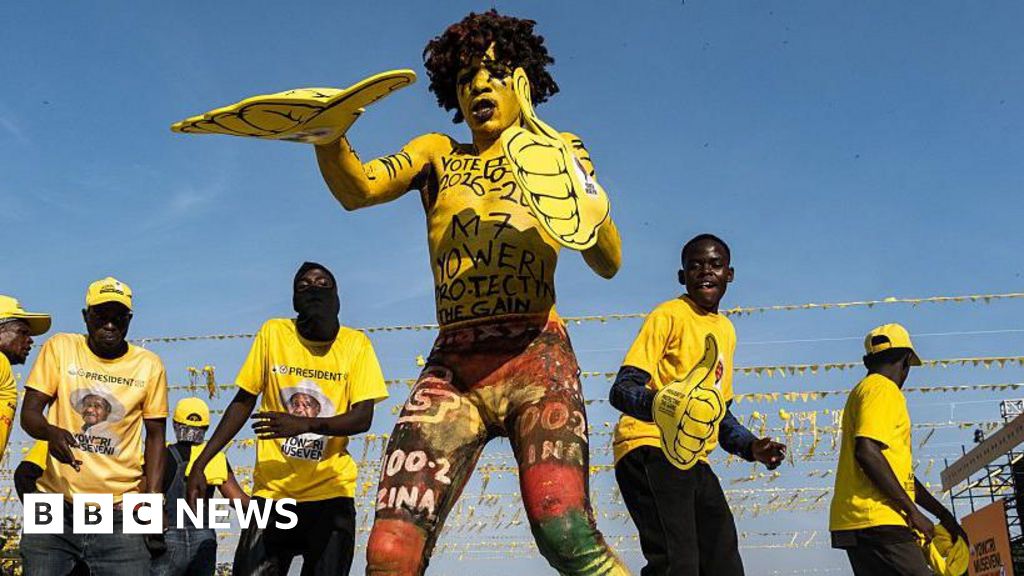
    Bloomberg via Getty Images Supporters of Yoweri Museveni, Uganda's president, dance during a campaign rally ahead of presidential elections in Kampala, Uganda, on Tuesday, Jan. 13, 2026Bloomberg via Getty Images

    For supporters of Uganda’s President Yoweri Museveni, his resounding victory in the just-concluded election is a vindication of his 40-year-long rule.

    He won with 72% of the vote, close to his highest-ever tally of 74% in Uganda’s first direct presidential election in 1996.

    It reinforces the 81-year-old’s claim that he still commands the support of the overwhelming majority of Ugandans, after seizing power as a rebel commander in 1986 ending the rule of the Milton Obote regime.

    But Museveni’s main election rival – the charismatic former pop star Bobi Wine – dismissed the result as “fake” and said he had gone into hiding following a raid on his home by the security forces.

    Museveni campaigned largely on his track-record, arguing that he has delivered political and economic stability in an era of global uncertainty.

    He pledged to steer Uganda towards achieving the status of a middle-income country by 2030, a milestone his supporters have framed as a fitting legacy for a man who will finish his seventh – and possibly final – term the following year.

    Museveni sees Uganda’s nascent oil industry as a central pillar towards achieving that goal.

    On the campaign trail, he repeatedly told voters that once exports commence, the economy would grow at double-digit rates.

    Museveni has set October as the target date for the first crude oil exports, via a 1,443 km pipeline to the Indian Ocean port of Tanga in Tanzania.

    Despite his age, the president has sought to project vitality and control. At one of his final campaign rallies, he told supporters that he had visited all of Uganda’s more than 140 electoral constituencies.

    Yet in early October, his team abruptly cancelled several campaign events, citing unspecified “state duties” – an explanation many found unconvincing, fuelling speculation about the octogenarian’s health.

    Subsequent pauses in his schedule only deepened speculation about fatigue and declining health.

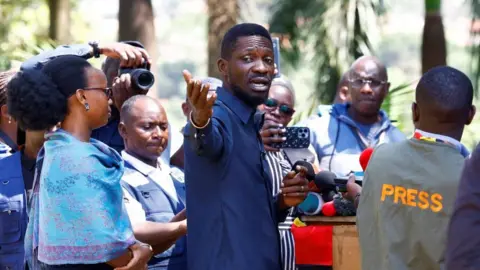
    Reuters Robert Kyagulanyi, also known as Bobi Wine, of the National Unity Platform (NUP) party, stands with his wife Barbara Kyagulanyi, as he addresses a press conference as they prepare to leave their Magere home to vote in the general election, in Kasangati town near Kampala, Uganda January 15, 2026Reuters

    Bobi Wine has now twice failed to dislodge President Museveni from power

    For Wine, the result was a massive blow. His share of the vote slumped from 35% in 2021 to 25% this time round, despite Uganda’s overwhelmingly young population – a demographic long viewed as the 43-year-old natural base.

    From Wine’s perspective, the election was neither credible nor legitimate.

    He maintains that the campaign was far from free and fair, pointing to repeated disruptions of his rallies by security forces, including the use of tear gas and live ammunition to intimidate supporters, some of whom were killed.

    He also alleged ballot stuffing but has not provided any evidence to back his claims. The authorities have not commented on the claims.

    After two unsuccessful presidential bids, questions now hang over his political future.

    There is a growing risk that he could follow the path of many opposition figures across Africa – politicians whose popular appeal was steadily eroded by sustained repression, leaving them permanently excluded from power.

    During the campaign, Wine embodied the energy and impatience of Uganda’s youth, while Museveni cast himself as the seasoned patriarch, the guarantor of stability.

    Ultimately, according to the disputed official results, voters opted for the latter.

    Those seeking to understand Uganda’s next chapter have largely focused on the question of presidential succession – when and how Museveni will eventually exit the stage.

    Ugandan journalist and political analyst Allan Kasujja – a former BBC Newsday radio and podcast presenter – cautions against being fixated with the issue.

    “Change in Uganda, especially political change, does not, and almost certainly will not, happen suddenly,” Kasujja says.

    “It happens gradually, and that process has been under way for some time.”

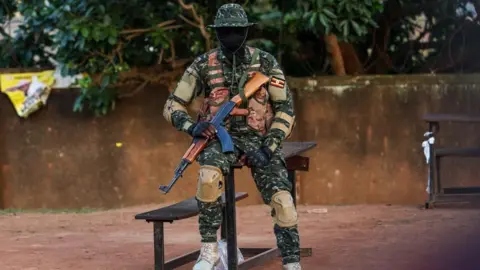
    EPA / Shutterstock A member of Uganda security forces operates during the opening of ballot boxes during the presidential elections in Kampala, Uganda, 15 January 2026. Eight presidential candidates, including incumbent Yoweri Museveni and NUP candidate Bobi Wine, are vying for the presidency.
Uganda holds presidential elections, Kampala - 15 Jan 2026EPA / Shutterstock

    Uganda’s security forces have been accused of brutally cracking down on the opposition

    Viewed through that lens, the election appears less a moment of transformation than a ritual of the political calendar, one that legitimises deeper, slower shifts taking place within the ruling party, the National Resistance Movement (NRM), and the state machinery that it controls.

    These shifts were first noticed during a cabinet reshuffle by Museveni in March 2023, and became unmistakable in the August 2025 elections for the NRM’s top decision-making body, the Central Executive Committee.

    Far from being a routine internal contest, the process turned into a high-stakes struggle over positioning in a post-Museveni order.

    Marked by factional bargaining and allegations of widespread bribery, the elections revealed a regime increasingly driven by succession politics rather than competition with an opposition that had either been dealt with by the security forces or co-opted.

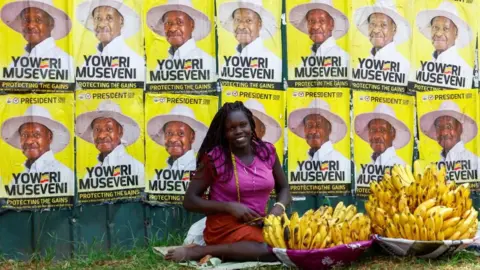
    Reuters A woman sells bananas near campaign posters of Uganda's President and the leader of ruling National Resistance Movement (NRM) party, Yoweri Museveni, following the general elections in Kampala, Uganda January 17, 2026Reuters

    The opposition says the election was marred by rigging and intimidation

    It provided the clearest indication yet of the growing influence within the ruling party of army chief Gen Muhoozi Kainerugaba – the son of the president and his potential successor.

    Veteran figures from the party’s old guard were pushed aside, replaced by newer faces, many without the credentials of having fought in the war that brought Museveni to power 40 years ago, but widely seen as loyal to his son.

    According to sources close to the presidency, authority at State House has become increasingly decentralised, with decisions once taken directly by Museveni now channelled through a tight inner circle of relatives and long-time associates.

    Museveni’s day-to-day schedule is said to be overseen by his eldest daughter, Natasha Karugire.

    Relations with foreign dignitaries and senior military figures are largely managed by his half-brother, Salim Saleh, while trade and economic policy are shaped by his son-in-law, Odrek Rwabwogo, married to Museveni’s second daughter, Patience.

    And for the first time in the country’s modern history, all security matters – both internal and external – are overseen by the chief of defence forces, the 51-year-old Gen Kainerugaba.

    Given the dominant role that the military has long played in Ugandan politics and the fact that Museveni himself came to power through armed struggle, this concentration of authority in his hands has profound political implications.

    It suggests that Uganda’s future is being shaped – and increasingly controlled – by Museveni’s son, even if he does not hold the title of head of state, yet.

    BBC election graphics
    Getty Images/BBC A woman looking at her mobile phone and the graphic BBC News AfricaGetty Images/BBC


    Source link

  • Black Basta Ransomware Leader Added to EU Most Wanted and INTERPOL Red Notice

    Black Basta Ransomware Leader Added to EU Most Wanted and INTERPOL Red Notice


    Ravie LakshmananJan 17, 2026Law Enforcement / Cybercrime

    Ukrainian and German law enforcement authorities have identified two Ukrainians suspected of working for the Russia-linked ransomware-as-a-service (RaaS) group Black Basta.

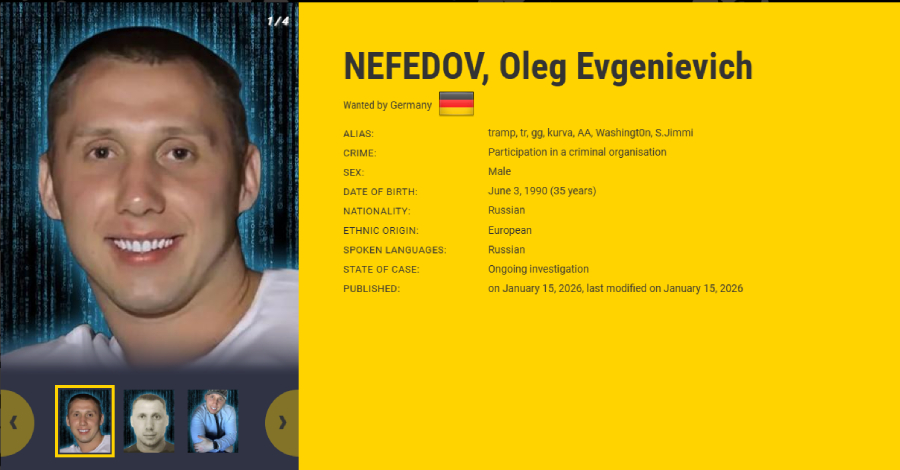
    In addition, the group’s alleged leader, a 35-year-old Russian national named Oleg Evgenievich Nefedov (Нефедов Олег Евгеньевич), has been added to the European Union’s Most Wanted and INTERPOL’s Red Notice lists, authorities noted.

    “According to the investigation, the suspects specialized in technical hacking of protected systems and were involved in preparing cyberattacks using ransomware,” the Cyber Police of Ukraine said in a statement.

    The agency said the accused individuals functioned as “hash crackers,” who specialize in extracting passwords from information systems using specialized software. Once the credential information was obtained, members of the ransomware group broke into corporate networks and ultimately deployed ransomware and extorted money to recover the encrypted information.

    Cybersecurity

    Authorities conducted searches at the defendants’ residences located in Ivano-Frankivsk and Lviv, allowing them to seize digital storage devices and cryptocurrency assets.

    Black Basta first emerged in the threat landscape in April 2022, and is said to have targeted more than 500 companies across North America, Europe, and Australia. The ransomware group is estimated to have earned hundreds of millions of dollars in cryptocurrency from illicit payments.

    Early last year, a year’s worth of internal chat logs from Black Basta leaked online, offering a glimpse into the group’s inner workings, its structure and key members, and the various security vulnerabilities exploited to gain initial access to organizations of interest.

    The leaked dossier also unmasked Nefedov as Black Basta’s ringleader, adding he goes by various aliases, such as Tramp, Trump, GG, and AA. Some documents alleged that Nefedov had ties to high-ranking Russian politicians and intelligence agencies, including the FSB and GRU.

    Nefedov is believed to have leveraged these connections to protect his operations and evade international justice. A subsequent analysis from Trellix revealed that Nefedov was able to secure his freedom despite getting arrested in Yerevan, Armenia, in June 2024. His other aliases include kurva, Washingt0n, and S.Jimmi. Although Nefedov is said to be in Russia, his exact whereabouts are unknown.

    Furthermore, there is evidence linking Nefedov to Conti, a now-defunct group that sprang forth in 2020 as a successor to Ryuk. In August 2022, the U.S. State Department announced a $10 million reward for information related to five individuals associated with the Conti ransomware group. They included Target, Tramp, Dandis, Professor, and Reshaev.

    It’s worth mentioning here that Black Basta surfaced as an autonomous group, alongside BlackByte and KaraKurt, following the retirement of the Conti brand in 2022. Other members joined groups like BlackCat, Hive, AvosLocker, and HelloKitty, all of which are now no longer active.

    Cybersecurity

    “He served as the head of the group. As such, he decided who or which organisations would be the targets of attacks, recruited members, assigned them tasks, took part in ransom negotiations, managed the ransom obtained by extortion, and used it to pay the members of the group,” Germany’s Federal Criminal Police Office (BKA or Bundeskriminalamt) said.

    The leaks have led to Black Basta’s apparent demise, with the group remaining silent after February and taking down its data leak later that month. But with ransomware gangs known to shut down, rebrand, and reemerge under a different identity, it won’t be surprising if members of the erstwhile criminal syndicate pivot to other ransomware groups or form new ones.

    Indeed, per reports from ReliaQuest and Trend Micro, it’s suspected that several of the former Black Basta affiliates might have migrated to the CACTUS ransomware operation – an assessment based on the fact that there was a massive spike in organizations named on the latter’s data leak site in February 2025, coinciding with Black Basta’s site going offline.


    Source link