Category: Uncategorized

  • Android Malware Operations Merge Droppers, SMS Theft, and RAT Capabilities at Scale

    Android Malware Operations Merge Droppers, SMS Theft, and RAT Capabilities at Scale


    Android Malware

    Threat actors have been observed leveraging malicious dropper apps masquerading as legitimate applications to deliver an Android SMS stealer dubbed Wonderland in mobile attacks targeting users in Uzbekistan.

    “Previously, users received ‘pure’ Trojan APKs that acted as malware immediately upon installation,” Group-IB said in an analysis published last week. “Now, adversaries increasingly deploy droppers disguised as legitimate applications. The dropper looks harmless on the surface but contains a built-in malicious payload, which is deployed locally after installation – even without an active internet connection.”

    Wonderland (formerly WretchedCat), according to the Singapore-headquartered cybersecurity company, facilitates bidirectional command-and-control (C2) communication to execute commands in real-time, allowing for arbitrary USSD requests and SMS theft. It masquerades as Google Play, or files of other formats, such as videos, photos, and wedding invitations.

    The financially motivated threat actor behind the malware, TrickyWonders, leverages Telegram as the primary platform to coordinate various aspects of the operation. First discovered in November 2023, it’s also attributed to two dropper malware families that are designed to conceal the primary encrypted payload –

    • MidnightDat (First seen on August 27, 2025)
    • RoundRift (First seen on October 15, 2025)

    Wonderland is mainly propagated using fake Google Play Store web pages, ad campaigns on Facebook, bogus accounts on dating apps, and messaging apps like Telegram, with the attackers abusing stolen Telegram sessions of Uzbek users sold on dark web markets to distribute APK files to victims’ contacts and chats.

    Once the malware is installed, it gains access to SMS messages and intercepts one-time passwords (OTPs), which the group uses to siphon funds from victims’ bank cards. Other capabilities include retrieving phone numbers, exfiltrating contact lists, hiding push notifications to suppress security or one-time password (OTP) alerts, and even sending SMS messages from infected devices for lateral movement.

    Cybersecurity

    However, it’s worth pointing out that sideloading the app first requires users to enable a setting that allows installation from unknown sources. This is accomplished by displaying an update screen that instructs them to “install the update to use the app.”

    “When a victim installs the APK and provides the permissions, the attackers hijack the phone number and attempt to log into the Telegram account registered with that phone number,” Group-IB said. “If the login succeeds, the distribution process is repeated, creating a cyclical infection chain.”

    Wonderland represents the latest evolution of mobile malware in Uzbekistan, which has shifted from rudimentary malware such as Ajina.Banker that relied on large-scale spam campaigns to more obfuscated strains like Qwizzserial that were found disguised as seemingly benign media files.

    The use of dropper applications is strategic as it causes them to appear harmless and evade security checks. In addition, both the dropper and SMS stealer components are heavily obfuscated and incorporate anti-analysis tricks to make them a lot more challenging and time-consuming to reverse engineer.

    What’s more, the use of bidirectional C2 communication transforms the malware from a passive SMS stealer to an active remote-controlled agent that can execute arbitrary USSD requests issued by the server.

    “The supporting infrastructure has also become more dynamic and resilient,” the researchers said. “Operators rely on rapidly changing domains, each of which is used only for a limited set of builds before being replaced. This approach complicates monitoring, disrupts blacklist-based defenses, and increases the longevity of command and control channels.”

    The malicious APK builds are generated using a dedicated Telegram bot, which is then distributed by a category of threat actors called workers in exchange for a share of the stolen funds. As part of this effort, each build is associated with its own C2 domains so that any takedown attempt does not bring down the entire attack infrastructure.

    The criminal enterprise also includes group owners, developers, and vbivers, who validate stolen card information. This hierarchical structure reflects a new maturation of the financial fraud operation.

    “The new wave of malware development in the region clearly demonstrates that methods of compromising Android devices are not just becoming more sophisticated – they are evolving at a rapid pace,” Group-IB said. Attackers are actively adapting their tools, implementing new approaches to distribution, concealment of activity, and maintaining control over infected devices.”

    The disclosure coincides with the emergence of new Android malware, such as Cellik, Frogblight, and NexusRoute, that are capable of harvesting sensitive information from compromised devices.

    Cellik, which is advertised on the dark web for a starting price of $150 for one month or for $900 for a lifetime licence, is equipped with real-time screen streaming, keylogging, remote camera/microphone access, data wiping, hidden web browsing, notification interception, and app overlays to steal credentials.

    Perhaps the Trojan’s most troubling feature is a one-click APK builder that allows customers to bundle the malicious payload within legitimate Google Play apps for distribution.

    “Through its control interface, an attacker can browse the entire Google Play Store catalogue and select legitimate apps to bundle with the Cellik payload,” iVerify’s Daniel Kelley said. “With one click, Cellik will generate a new malicious APK that wraps the RAT inside the chosen legitimate app.”

    Frogblight, on the other hand, has been found to target users in Turkey via SMS phishing messages that trick recipients into installing the malware under the pretext of viewing court documents related to a court case they are purported to be involved in, Kaspersky said.

    Besides stealing banking credentials using WebViews, the malware can collect SMS messages, call logs, a list of installed apps on the device, and device file system information. It can also manage contacts and send arbitrary SMS messages.

    Cybersecurity

    Frogblight is believed to be under active development, with the threat actor behind the tool laying the groundwork for it to be distributed under a malware-as-a-service (MaaS) model. This assessment is based on the discovery of a web panel hosted on the C2 server and the fact that only samples using the same key as the web panel login can be remotely controlled through it.

    Malware families like Cellik and Frogblight are part of a growing trend of Android malware, wherein even attackers with little to no technical expertise can now run mobile campaigns at scale with minimal effort.

    In recent weeks, Android users in India have also been targeted by a malware dubbed NexusRoute that employs phishing portals impersonating the Indian government services to redirect visitors to malicious APKs hosted on GitHub repositories and GitHub Pages, while simultaneously collecting their personal and financial information.

    The bogus sites are designed to infect Android devices with a fully obfuscated remote access trojan (RAT) that can steal mobile numbers, vehicle data, UPI PINs, OTPs, and card details, as well as harvest extensive data by abusing accessibility services and prompting users to set it as the default home screen launcher.

    “Threat actors increasingly weaponize government branding, payment workflows, and citizen service portals to deploy financially driven malware and phishing attacks under the guise of legitimacy,” CYFIRMA said. “The malware performs SMS interception, SIM profiling, contact theft, call-log harvesting, file access, screenshot capture, microphone activation, and GPS tracking.”

    Further analysis of an embedded email address “gymkhana.studio@gmail[.]com” has linked NexusRoute to a broader underground development ecosystem, raising the possibility that it’s part of a professionally maintained, large-scale fraud and surveillance infrastructure.

    “The NexusRoute campaign represents a highly mature, professionally engineered mobile cybercrime operation that combines phishing, malware, financial fraud, and surveillance into a unified attack framework,” the company said. “The use of native-level obfuscation, dynamic loaders, automated infrastructure, and centralized surveillance control places this campaign well beyond the capabilities of common scam actors.”


    Source link

  • Palm Springs Airport departures cancelled as air traffic control issues continue

    Palm Springs Airport departures cancelled as air traffic control issues continue


    A ground stop halting all departures from Palm Springs International Airport dragged on Saturday afternoon as the airport continued to be impacted by an air traffic control issue affecting Southern California airspace on a busy travel weekend following the New Year’s holiday.

    Airport spokesperson Jake Ingrassia wrote in a statement that while no planes were currently allowed to depart from PSP, some aircraft had arrived. But he added that some inbound flights had been diverted and “delays and schedule disruptions are expected.”

    The airline industry tracking website FlightAware showed 47 flights to or from PSP had been canceled on Saturday, while another 38 had been delayed as of around 3 p.m. The arrivals page on the airport website showed some flights still landing, though often after significant delays.

    Ingrassia’s statement did not elaborate on the nature or cause of the issue or say whether there was an “expectation” for how long it would take to resolve. He did say that the issues were not specific to Palm Springs and were affecting other Southern California airports.

    PSP continues to work closely with airline partners and the FAA, which is managing the situation,” Ingrassia wrote. “Travelers should contact their airline directly for the latest flight information. PSP will share additional updates as needed.”

    Related: Where to eat, shop at Palm Springs International Airport: Our guide to the new spots

    The Desert Sun also reached out to the Federal Aviation Administration, which manages air traffic control nationwide, for more information on the situation, but did not receive an immediate response.

    This is a developing situation. Check back later for more details.

    Paul Albani-Burgio covers growth, development, and business in the Coachella Valley. Email him at paul.albani-burgio@desertsun.com.

    This article originally appeared on Palm Springs Desert Sun: No departures at Palm Sprin airport as air traffic control woes worsen


    Source link

  • How UK plush toy Jellycat conquered China

    How UK plush toy Jellycat conquered China


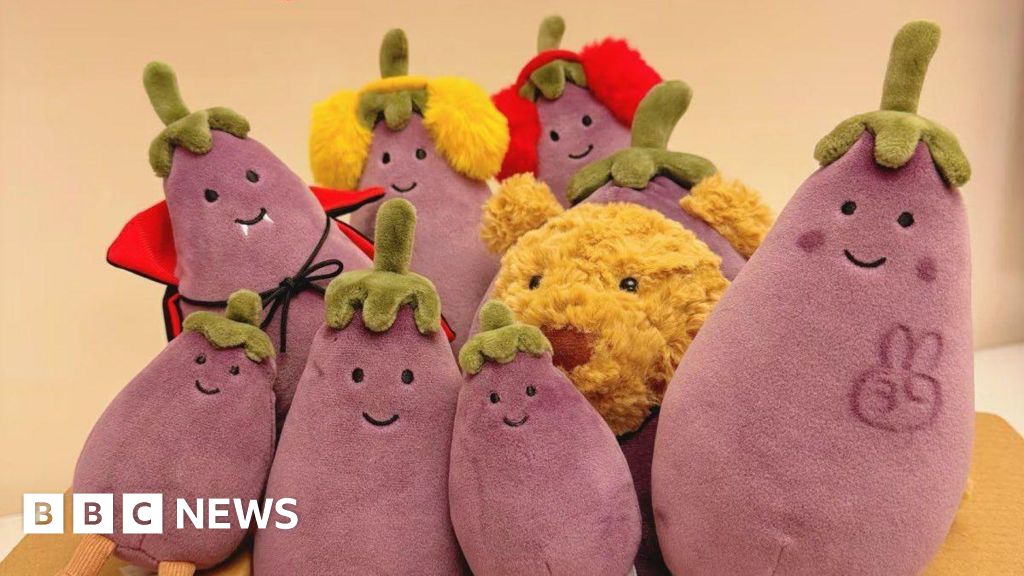
    RedNote / @I am a pie (826101674) Eight Jellycat aubergine plushies of different sizes surround a teddy bear at the centre. A peace sign is drawn on the rightmost aubergine.RedNote / @I am a pie (826101674)

    Grace Tsoi,BBC World Service, Hong Kongand

    Gemini Cheng,BBC News Chinese, Hong Kong

    Stella Huang bought her first Jellycat plush toy when she lost her job during the pandemic.

    A school friend was a fan of the British-designed toys and told her all about them. But she only fell in love with the brand when she saw a gingerbread house plushie on the Chinese social media app RedNote.

    Christmas is not widely celebrated in China and is more of a commercial event than anything more traditional. “The festival doesn’t mean a lot to me… But I always like the sight of gingerbread houses,” she says. It was then that she asked her friend in their hometown Guangzhou to buy it for her.

    That was in 2021, just as Jellycat was about to make it big in China and around the world.

    “Everyone felt jittery, and no-one knew what would happen,” says Stella, who has developed a habit of petting and squeezing her plushies since Covid. She had to spend a lot of time at her home, in Beijing, which had some of the strictest lockdowns in China, if not the world.

    Now 32, Stella has a new job, as a sales manager in the tourism industry, but is still buying Jellycats. Her collection has grown to 120 toys, costing a total of about 36,000 yuan ($5,145; £3,815).

    “At my age, there are many things you can’t share with others… and the troubles we face are a lot more complicated than before,” she says with a sigh. “The plushies help me regulate my emotions.”

    Originally aimed at children, the squishy toys have become a global hit, especially in China where a disenchanted youth has been turning to them for comfort.

    The kidults

    Stella’s Gingerbread house plushie is an “Amuseable”, a line of toys with tiny faces modelled on inanimate objects from toilet rolls to boiled eggs. The plushies are the “breakout products” which “appeal to a wide Gen-Z and millennial audience” around the world, says Kasia Davies of global analysis firm Statista.

    The popularity of these toys “may have something to do with wanting to feel companiable”, Isabel Galleymore of the University of Birmingham, in the UK, says.

    It is difficult to say for sure whether Jellycat started the now-iconic Amuseable line, which was launched in 2018, to tap into the young adult market. But toy manufacturers need to find a new market given the falling birth rate in much of the world, Ms Davies adds.

    And as early as in 2015, Jellycat entered the Chinese market.

    Having done the “groundwork”, the toy maker was able to capture “the tone of the pandemic” – when people sought comfort amid heightened uncertainty – and built on its success in China, says Kathryn Read, a business consultant with 15 years’ experience in China.

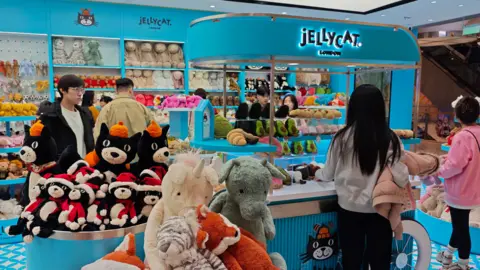
    Jellycat’s popularity was further propelled by its pop-up experiences. The in-store events offer a menu of limited-edition “food”. Many fans film themselves being served and post the clips on social media.

    Localisation has also been a core strategy for the Jellycat experience. Fans could buy stuffed toy versions of items like fish, chips and mushy peas at a temporary shop at the department store Selfridges in London.

    Meanwhile, teapot and teacup plushies were among the items sold at special outlets in Beijing and Shanghai last year.

    In 2024, the UK-based firm’s revenue rose by two-thirds to £333m ($459m), according to its most recent Companies House accounts. In the same period, it sold about $117m worth of toys to Chinese consumers on major e-commerce platforms, according to estimates by Beijing-based Moojing Market Intelligence.

    The company’s growing popularity mirrors a wider boom in China’s collectable-toy market among young adults seeking emotional comfort and connection.

    Overall sales of collectable toys in China are expected to top 110bn yuan this year, according to a 2024 report by the Chinese Academy of Social Sciences and the China Animation Association.

    The runaway success of Labubu, the elf-like dolls created by Chinese toy maker Pop Mart, highlights the country’s growing appetite for collectable toys, especially among young people.

    This “kidult” trend is not unique to China, as young adults around the world question “outdated understandings of adulthood”, says Prof Erica Kanesaka, a cultural expert at Emory University in the US.

    Global toy sales fell in 2024 – albeit by less than 1% – but collectable toy sales rose by almost 5%, to a record high, according to market research company Circana.

    CFOTO/Future Publishing via Getty Images Customers shop at jellycat doll store in Shanghai, China.CFOTO/Future Publishing via Getty Images

    Jellycat had pop-up stores in Shanghai and Beijing

    Jellycat Chinese actress Yang Mi, in a white top, holds a matcha latte plushie at the Jellycat pop-up store in ShanghaiJellycat

    In September, Jellycat partnered with A-list actress Yang Mi during a pop-up event in Shanghai

    Amuseables, especially the aubergine, which Chinese fans call “the boss”, have also spawned memes, with many sharing frustrations about adult life.

    “Aubergine boss” is a hashtag on RedNote, where fans draw different expressions on the plushie. In these memes, the aubergine appears in various moods from drinking to fake-smiling.

    For example, Wendy Hui from Hong Kong modified her aubergine Amuseable by drawing dark circles around its eyes and putting a pair of glasses on it. She then posted a picture of it on Threads with the caption: “The mental state of workers on Monday.”

    “I kept working at home even when I was supposed to be off,” the 30-something marketing professional says. “I just wanted to express how exhausted I was.”

    Jellycat has become an unexpected, light-hearted outlet for young Chinese people to air their grievances about a slowing economy, where hard work doesn’t guarantee comparable rewards. Despite heavy censorship, the internet has remained an important, if not the only, space for such conversations.

    The brand also often launches limited-edition products and retires designs. The strategy, which many in China call “hunger marketing”, has also helped make Jellycat toys a favourite on social media in the country.

    Collecting can feel like a treasure hunt, with fans combing department stores and independent shops for Jellycats when they travel overseas. Some resort to “daigou”, overseas-based shopping agents. And rare Jellycats, a status symbol among some fans, change hands for more than $1,400.

    But most are cheap pick-me-ups amid a sluggish economy plagued by a property crisis and high local government debt. China’s youth unemployment rate has eased a little after hitting a record high in August, but official figures show it is still above 17%.

    “You have to consider for a long time before buying a luxury bag,” 34-year-old medical sales representative Jessie Chen says. “But you don’t need to do that for a Jellycat.

    “Jellycat also sells bags, which cost just a few hundred yuan [tens of US dollars]. They are practical and can hold a lot of things, so you might change the way you think about luxury goods.”

    ‘Quitting the pit’

    But China may have already reached peak Jellycat, with fans noticing less discussion about the toys on social media.

    Ms Hui has turned to “blind boxes” of toys like Teletubbies – where customers only find out what they have bought when they open the package – as a more thrilling, and cheaper, alternative. She has even considered “quitting the pit” – Chinese slang for retiring a hobby.

    “It is so difficult to buy them,” Stella says. “Our daily life is not easy already and why should we make things harder for ourselves?”


    Source link