Category: Uncategorized

  • European military personnel arrive in Greenland as Trump says US needs island

    European military personnel arrive in Greenland as Trump says US needs island


    Paul KirbyEurope digital editor

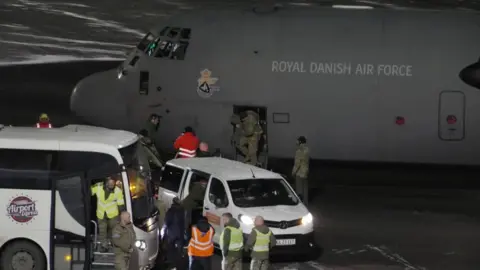
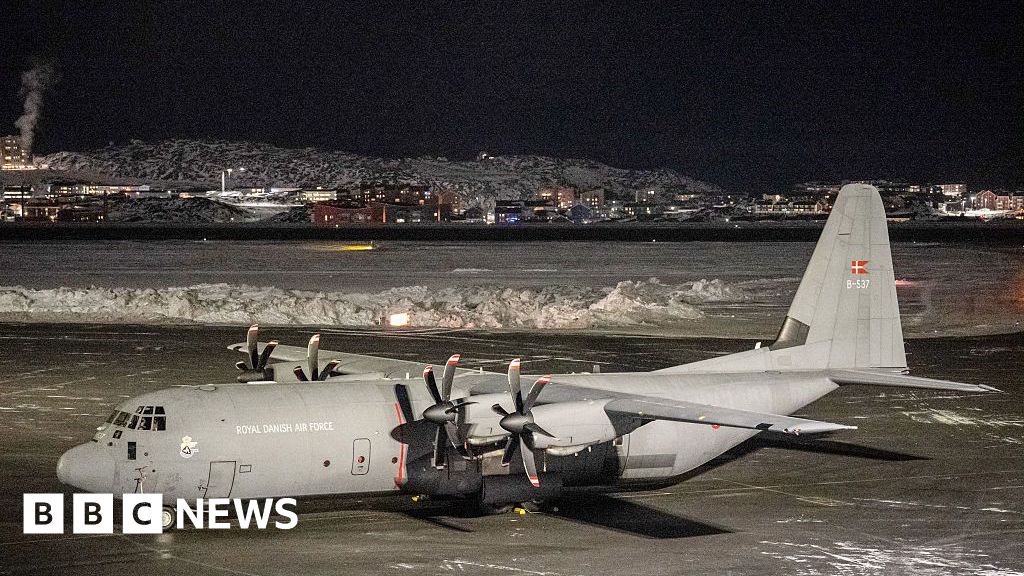
    Reuters A plane with the Royal Danish Air Force livery stands on the tarmac at Nuuk airportReuters

    A Danish air force transport plane arrived in Greenland as European Nato allies deployed to the capital, Nuuk, for joint exercises

    A 15-strong French military contingent has arrived in the Greenland capital Nuuk, as several European states send soldiers there as part of a so-called reconnaissance mission.

    The deployment, which will also include personnel from Germany, Sweden, Norway and the UK, comes as US President Donald Trump continues to press his claim to the Arctic island, which is a semi-autonomous part of Denmark.

    French President Emmanuel Macron said the initial troop deployment would be reinforced in the coming days with “land, air, and sea assets”.

    Senior French diplomat Olivier Poivre d’Arvor saw the mission as sending a strong political signal: “This is a first exercise… we’ll show the US that Nato is present.”

    The movement of military personnel comes after Denmark and Greenland’s foreign ministers travelled to Washington for a meeting with US Vice-President JD Vance on Wednesday.

    Following the meeting, Danish Foreign Minister Lars Lokke Rasmussen said while the talks were constructive, there remained a “fundamental disagreement” between the two sides and later criticised Trump’s bid to buy Greenland.

    Trump, meanwhile, doubled down on his bid to bring Greenland under US control, telling reporters in the Oval Office, “we need Greenland for national security”. Although he did not rule out the use of force, he said late on Wednesday that he thought something could be worked out with Denmark.

    “The problem is there’s not a thing that Denmark can do about it if Russia or China wants to occupy Greenland, but there’s everything we can do. You found that out last week with Venezuela.”

    Polish Prime Minister Donald Tusk said Poland was not planning to join the European military deployment to Greenland, but warned that any US military intervention there “would be a political disaster”.

    “A conflict or attempted annexation of the territory of a Nato member by another Nato member would be the end of the world as we know it – and which for many years guaranteed our security,” he told a press conference.

    Russia’s embassy in Belgium meanwhile expressed “serious concern” at what was unfolding in the Arctic, accusing Nato of building up a military presence there “under the false pretext of a growing threat from Moscow and Beijing”.

    However, the European Nato deployment consists of only a few dozen personnel as part of Danish-led joint exercises called Operation Arctic Endurance. While heavy in symbolism, it was not immediately clear how long they would stay.

    Germany was sending an A400M transport plane to Nuuk on Thursday with a contingent of 13 soldiers, although officials said they would stay in Greenland only until Saturday.

    Danish defence officials said they had decided with the government of Greenland that there would be an increased military presence around Greenland in the coming period to bolster Nato’s “footprint in the Arctic for the benefit of both European and transatlantic security”.

    Macron, in his new year address to France’s armed forces, said Europeans had a special responsibility to Greenland “because this territory belongs to the European Union and it’s also one of our Nato allies”.

    The US already has a military base in Greenland, currently staffed by up to 150 people, and has the option of bringing in far greater numbers under existing agreements with Copenhagen. But the Danish-led initiative is seen as signalling to the Trump administration that its European allies also have a stake in security in the Arctic and North Atlantic.

    Sweden’s prime minister said Swedish army officers had been sent to Nuuk on Wednesday. Two Norwegians and one British military officer were also being sent.

    Downing Street said the UK shared President Trump’s concern about “the security of the High North”, and said the deployment involved “stepping up with stronger exercising, to deter the Russian aggression and the Chinese activity.”

    Danish Prime Minister Mette Frederiksen said on Thursday that defence and protection of Greenland was a common concern for the entire Nato alliance.

    Watch: What message do Greenlanders want to send to Trump?

    Danish Defence Minister Troels Lund Poulsen said the intention was to have a military presence “in rotation”, with the aim of having a more permanent military presence on the island with foreign allies taking part in exercise and training activities.

    Copenhagen has disputed Trump’s justification for wanting to control Greenland. Rasmussen, its foreign minister, said on Wednesday there was no “instant threat” from China or Russia that Denmark and Greenland could not accommodate, although he shared American security concerns to some extent.

    A Democratic-led US delegation is due to visit Denmark on Friday for talks with Danish MPs.

    Rasmussen spoke alongside Greenland’s foreign minister after talks with Vance and US Secretary of State Marco Rubio on Wednesday.

    “The president’s ambition is on the table,” the Danish diplomat told Fox News. “Of course we have our red lines. This is 2026, you trade with people but you don’t trade people.”

    Greenland’s Prime Minister, Jens-Frederik Nielsen, said this week that the territory was in the midst of a geopolitical crisis, and that if his people were asked to make a choice they would choose Denmark over the US.

    “Greenland does not want to be owned by the United States. Greenland does not want to be governed by the United States. Greenland does not want to be part of the United States,” he stressed.

    Source link

  • Yoweri Museveni faces Bobi Wine in presidential poll

    Yoweri Museveni faces Bobi Wine in presidential poll


    Sammy Awami,BBC Africa, Kampalaand

    Wycliffe Muia

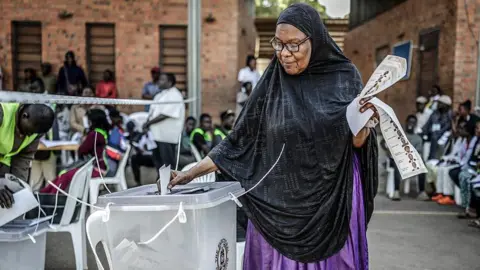
    AFP via Getty Images A voter in a black headscarf places her vote in a ballot box.AFP via Getty Images

    More than 21 million Ugandans have registered to vote

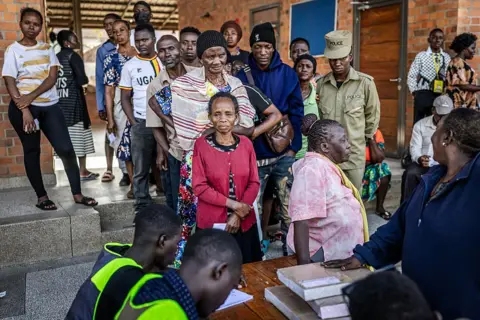
    Logistical problems have delayed voting in Uganda’s presidential and parliamentary elections in many parts of the country amid an internet shutdown.

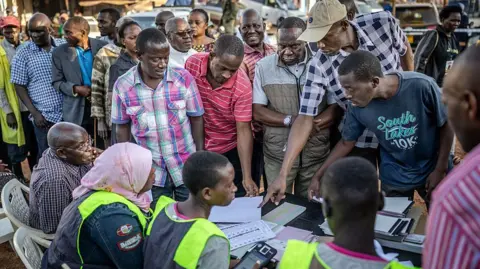
    The BBC observed growing frustration among voters queuing at some polling stations in the capital, Kampala, where voting had yet to start in the general election.

    The delays have been blamed on failures of biometric identification kits, which some have linked to the network outage, as well as a lack of equipment in some places.

    The electoral agency has apologised for the “technical glitches” and said officials were working to resolve them.

    AFP via Getty Images Voters gather around a desk speaking with electoral officials in Kampala AFP via Getty Images

    Voters in parts of the capital, Kampala, found polling stations still not open hours after voting was due to start

    In the presidential race, Yoweri Museveni, 81, in power since 1986, is seeking a seventh successive victory as he faces a challenge from Bobi Wine, a charismatic 43-year-old pop star.

    Where voting has been taking place, there are reports that the biometric machines used to verify voters’ identities are still malfunctioning in some areas.

    Delays have also been caused by polling materials and equipment failing to arrive at some stations on time.

    “I’m angry because I have not voted up to now. We are meant to start at seven, but up to now we haven’t started. The ballots papers are not even there, I don’t even know what to say” Kaweesi Ismail, a voter in Kampala, told the BBC.

    Casting his vote in his native Rwakitura Village in the western Mbarara region, Museveni said he had also experienced difficulties.

    “I put my thumbprint on the machine but it did not accept it. However, my face was accepted instantly by the machine. The machine works,” he said.

    Asked if he would accept the election outcome, the president said: “This is one of the manipulations – we have to find out why, what was the problem?”

    “We are now verifying whether this was deliberate,” he added.

    Election chief Simon Byabakama ordered the use of the national voters’ register where biometric machines failed to function.

    “It is the primary duty of the Electoral Commission to ensure that no citizen is disenfranchised due to machine failure,” he said.

    The problems appear to be affecting both areas seen as pro-government as well as those seen as opposition strongholds.

    In a post on X, Wine said the biometric machines “have failed everywhere”, alleging widespread irregularities and the arrest of his agents as voting got under way.

    The country’s law allows polling hours to be extended if challenges disrupt the voting process.

    “Polling stations will remain open until all registered voters in the queue by 4:00 pm (13:00 GMT) have cast their votes,” said Byabakama.

    The presidential poll is essentially a two-horse race between Museveni and Wine, but given the president has won the six previous elections, analysts say he is likely to further extend his time in power.

    Wine has promised to tackle corruption and impose sweeping reforms, while Museveni argues he is the sole guarantor of stability and progress in the country.

    The result of the presidential vote will be announced by 16:00 local time (13:00 GMT) on Saturday, the electoral commission has said.

    The campaign period was marred by the disruption of opposition activities – security forces have been accused of assaulting and detaining Wine’s supporters.

    Police spokesperson Kituuma Rusoke dismissed these complaints, accusing opposition supporters, particularly those belonging to Wine’s National Unity Platform (NUP) party, of being disruptive.

    Internet access was suspended ahead of voting day, with Uganda’s Communications Commission saying the blackout was necessary to prevent misinformation, fraud and the incitement of violence – a move condemned by the UN human rights office as “deeply worrying”.

    The NUP has rejected this explanation, accusing the regulator of trying to stop the opposition from mobilising and sharing evidence of election fraud. The party has launched an offline vote-monitoring app in case of a blackout.

    The app, called Bitchat, uses Bluetooth technology to share images of the results forms from polling stations and voting data without internet access, according to Wine.

    The former leader of a guerrilla army, Museveni has benefitted from two constitutional amendments – removing age and term limits – that have allowed him to keep running for office.

    Wine, real name Robert Kyagulanyi, lost to the president in the 2021 elections. According to the electoral commission, he gained 35% of the vote compared to Museveni’s 59%, although Wine dismissed the results, alleging fraud.

    Alongside Museveni and Wine, six other presidential candidates are on this year’s ballot papers.

    Voters will also chose a new parliament, with 353 seats up for grabs.

    For many of those voting on Thursday, the economy is the key issue.

    The majority of the population is under 30 and although the average income is steadily rising, there are not enough jobs for all the young people looking for work.

    AFP via Getty Images Voters queue to cast their ballots at a polling station in Kampala AFP via Getty Images

    In some areas, officials had to switch to manual voter verification

    There are also concerns about poor infrastructure and disparities in access to quality education and healthcare.

    During the campaign period, opposition supporters have faced escalating harassment, including arrest on politically motivated charges, according to both the United Nations and Amnesty International.

    Wine’s rallies, unlike those of Museveni, have been disrupted by security forces.

    Amnesty has described the use of tear gas, pepper spray, beatings and other violent acts as “a brutal campaign of repression” ahead of the vote.

    In addition, the head of Uganda’s electoral body told the BBC he has received threats warning him against declaring certain results.

    The 2021 elections were also characterised by violence – dozens of people were killed in protests and the security forces were responsible for at least some of these deaths, a BBC investigation found.

    Since Saturday, security has been heightened in Kampala, Uganda’s capital city.

    Officers have been marching in formation and conducting patrols, while armoured vehicles have been stationed at various locations.

    Some Kampala residents have travelled to rural areas, saying they believe it is safer there during the election period.

    “Because Ugandan elections are often violent, I decided to re-register my polling centre in my home village,” one man told the BBC. He wished to remain anonymous.

    “I’m glad I made that decision, because as you can see now, there is a heavy and intimidating security presence in the city. So while I will still vote in my village, I am also staying away from this security scare.”

    Additional reporting by Wedaeli Chibelushi

    BBC election graphics
    Getty Images/BBC A woman looking at her mobile phone and the graphic BBC News AfricaGetty Images/BBC


    Source link

  • Astronauts return to Earth after medical evacuation

    Astronauts return to Earth after medical evacuation


    Four astronauts who left the International Space Station (ISS) a month early due to one of the crew members falling ill have returned to Earth on Thursday.

    Crew 11 disembarked the Dragon Endeavour at about 01:30 local time (09:30 GMT) after an 11 hour journey back to Earth, splashing down off the coast of California.

    The astronauts, Mike Fincke and Zena Cardman, Japan’s Kimiya Yui and cosmonaut Oleg Platonov, arrived on the ISS on 1 August expecting to complete a standard six and a half month stay.

    Nasa did not disclose details of the illness due to privacy reasons.


    Source link