Category: Uncategorized

  • Iran denies plan to execute detained protester

    Iran denies plan to execute detained protester


    Iran’s judiciary has denied it scheduled the execution of a man arrested in connection with the country’s recent protests.

    Norway-based Kurdish human rights organisation Hengaw said earlier this week that the family of Erfan Soltani, 26, had been told he faced execution on Wednesday, only days after he was detained.

    On Wednesday, Hengaw cited them as saying Soltani’s execution had been “postponed” but warned that “serious and ongoing concerns” regarding his life remained.

    The judiciary said he faced charges of “colluding against national security” and “propaganda activities against the establishment”, which are not punishable by the death penalty, state broadcaster IRIB reported.

    The judiciary said reports by foreign media organisations that Soltani faced execution was a “blatant act of news fabrication”.

    Iranian Foreign Minister Abbas Araghchi also said there was “no plan” to hang people.

    It came after President Donald Trump warned that the US would take “very strong action” if Iran executed protesters.

    On Wednesday, he told reporters that “very important sources on the other side” had informed him “the killing in Iran is stopping, and there’s no plan for executions”.

    Hengaw told the BBC that Soltani had been denied access to a lawyer and that his family were unaware of any official charges brought against him.

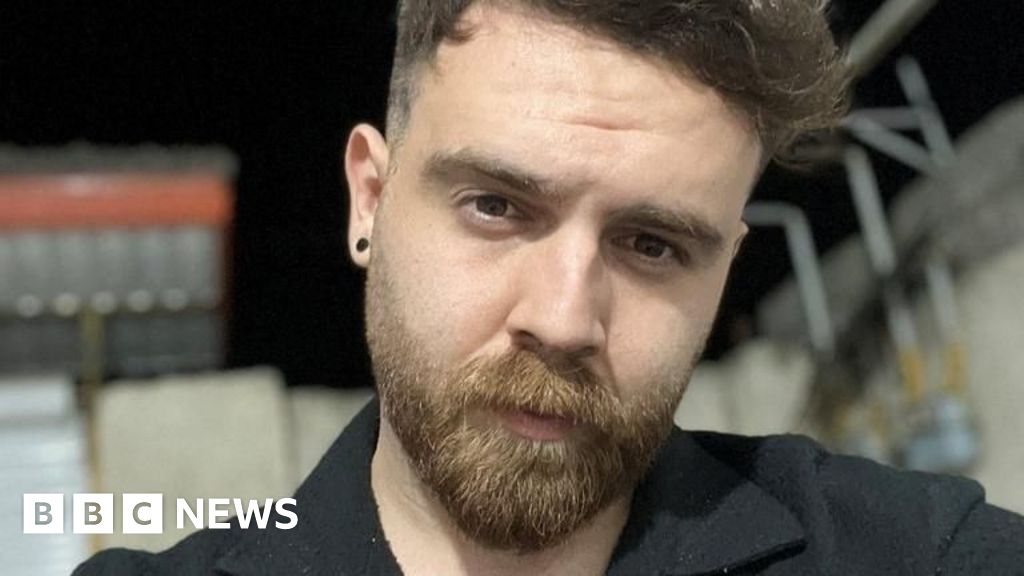
    Soltani, a clothes shop owner, was arrested at his home on last Thursday in connection with the protests in the northern city of Fardis, west of Tehran, according to the group and his family.

    However, the judiciary said he was arrested during “riots” on Saturday and was being held in a prison in the neighbouring city of Karaj.

    Iran’s chief justice, Gholam-Hossein Mohseni-Ejei, has advocated for the swift trial and punishment of arrested “rioters”.

    “Those elements who beheaded people in the streets or burned people alive must be tried and punished as quickly as possible,” he said in a video on Wednesday. “If we don’t do it fast, it won’t have the same impact.”

    The current wave of protests began after shopkeepers in Tehran went on strike over the rising cost of living and the depreciating value of the currency.

    They quickly spread across the country and turned against Iran’s clerical establishment, particularly the Supreme Leader, Ayatollah Ali Khamenei. The slogans chanted by demonstrators have included “Death to the dictator” and “Seyyed Ali [Khamenei] will be toppled this year”.

    The protests escalated significantly last Thursday and were met with deadly force by authorities, masked by a near total shutdown of the internet and communication services.

    According to the US-based Human Rights Activists News Agency (HRANA), at least 2,435 protesters have been killed since the unrest began, as well as 13 children and 153 people affiliated with the security forces or government.

    It reports that another 18,470 protesters have been arrested.


    Source link

  • Model Security Is the Wrong Frame – The Real Risk Is Workflow Security

    Model Security Is the Wrong Frame – The Real Risk Is Workflow Security


    Jan 15, 2026The Hacker NewsData Security / Artificial Intelligence

    As AI copilots and assistants become embedded in daily work, security teams are still focused on protecting the models themselves. But recent incidents suggest the bigger risk lies elsewhere: in the workflows that surround those models.

    Two Chrome extensions posing as AI helpers were recently caught stealing ChatGPT and DeepSeek chat data from over 900,000 users. Separately, researchers demonstrated how prompt injections hidden in code repositories could trick IBM’s AI coding assistant into executing malware on a developer’s machine.

    Neither attack broke the AI algorithms themselves.

    They exploited the context in which the AI operates. That’s the pattern worth paying attention to. When AI systems are embedded in real business processes, summarizing documents, drafting emails, and pulling data from internal tools, securing the model alone isn’t enough. The workflow itself becomes the target.

    AI Models Are Becoming Workflow Engines

    To understand why this matters, consider how AI is actually being used today:

    Businesses now rely on it to connect apps and automate tasks that used to be done by hand. An AI writing assistant might pull a confidential document from SharePoint and summarize it in an email draft. A sales chatbot might cross-reference internal CRM records to answer a customer question. Each of these scenarios blurs the boundaries between applications, creating new integration pathways on the fly.

    What makes this risky is how AI agents operate. They rely on probabilistic decision-making rather than hard-coded rules, generating output based on patterns and context. A carefully written input can nudge an AI to do something its designers never intended, and the AI will comply because it has no native concept of trust boundaries.

    This means the attack surface includes every input, output, and integration point the model touches.

    Hacking the model’s code becomes unnecessary when an adversary can simply manipulate the context the model sees or the channels it uses. The incidents described earlier illustrate this: prompt injections hidden in repositories hijack AI behavior during routine tasks, while malicious extensions siphon data from AI conversations without ever touching the model.

    Why Traditional Security Controls Fall Short

    These workflow threats expose a blind spot in traditional security. Most legacy defenses were built for deterministic software, stable user roles, and clear perimeters. AI-driven workflows break all three assumptions.

    • Most general apps distinguish between trusted code and untrusted input. AI models don’t. Everything is just text to them, so a malicious instruction hidden in a PDF looks no different than a legitimate command. Traditional input validation doesn’t help because the payload isn’t malicious code. It’s just natural language.
    • Traditional monitoring catches obvious anomalies like mass downloads or suspicious logins. But an AI reading a thousand records as part of a routine query looks like normal service-to-service traffic. If that data gets summarized and sent to an attacker, no rule was technically broken.
    • Most general security policies specify what’s allowed or blocked: don’t let this user access that file, block traffic to this server. But AI behavior depends on context. How do you write a rule that says “never reveal customer data in output”?
    • Security programs rely on periodic reviews and fixed configurations, like quarterly audits or firewall rules. AI workflows don’t stay static. An integration might gain new capabilities after an update or connect to a new data source. By the time a quarterly review happens, a token may have already leaked.

    Securing AI-Driven Workflows

    So, a better approach to all of this would be to treat the whole workflow as the thing you’re protecting, not just the model.

    How Platforms Like Reco Can Help

    In practice, doing all of this manually doesn’t scale. That’s why a new category of tools is emerging: dynamic SaaS security platforms. These platforms act as a real-time guardrail layer on top of AI-powered workflows, learning what normal behavior looks like and flagging anomalies when they occur.

    Reco is one leading example.

    Figure 1: Reco’s generative AI application discovery

    As shown above, the platform gives security teams visibility into AI usage across the organization, surfacing which generative AI applications are in use and how they’re connected. From there, you can enforce guardrails at the workflow level, catch risky behavior in real time, and maintain control without slowing down the business.

    Request a Demo: Get Started With Reco.

    Found this article interesting? This article is a contributed piece from one of our valued partners. Follow us on Google News, Twitter and LinkedIn to read more exclusive content we post.


    Source link

  • Astronauts splash down to Earth after medical evacuation from space station

    Astronauts splash down to Earth after medical evacuation from space station


    Georgina RannardScience reporter

    Watch: Astronauts return to Earth after medical evacuation

    Four astronauts evacuated from the International Space Station (ISS) have landed back on Earth after their stay in space was cut short by a month due to a “serious” medical issue.

    The crew’s captain, Nasa astronaut Mike Fincke, exited the spacecraft first, smiling and wobbling slightly on his feet before lying down on a gurney, following normal procedures.

    Nasa’s Zena Cardman, Japan’s Kimiya Yui and cosmonaut Oleg Platonov followed, waving and beaming at cameras. “It’s so good to be home!”, said Cardman.

    It is the first time astronauts have been evacuated due to a health issue since the station was put into Earth’s orbit in 1998.

    The team, known as Crew-11, will now receive medical checks before being flown back to land after the splash down off the coast of California.

    In a news conference after splash-down, Nasa administrator Jared Isaacman said the sick astronaut is “fine right now” and in “good spirits”.

    Judging by past Nasa communications about astronauts’ health, it is unlikely that the identity of the crew member or details of the health issue will be released to the public.

    Control of the ISS has been handed over to Russian cosmonaut Sergey Kud-Sverchkov and two other crew members.

    The astronauts arrived on the ISS on 1 August expecting to complete a standard six and a half month stay. They were due to come home in mid-February.

    Watch: Nasa Astronauts Medically Evacuated from ISS

    ut last week, a scheduled spacewalk by Fincke and Cardman was called off at the last minute. Hours later, Nasa revealed a crew member had become ill.

    “It’s bittersweet,” said Mr Fincke when he handed over the keys to the ISS to Kud-Sverchjov on Monday.

    In a social media post, he stressed that all crew members on board were “stable, safe, and well cared for”.

    Orbiting Earth at an altitude of 250 miles, the International Space Station (ISS) makes 16 orbits of our planet a day, travelling at a speed of 17,500 miles per hour.

    It is run by five space agencies and carries out wide-ranging scientific research about space and the effects on humans, animals and plants of living in microgravity.

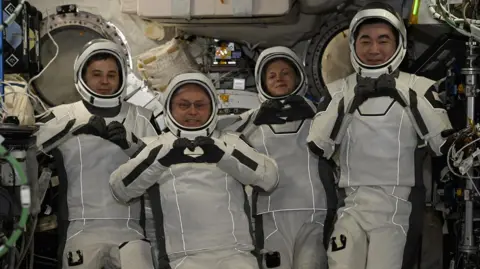
    NASA Four astronauts wearing white spacesuits and helmets pose for cameras smiling and making heart shapes with their hands and fingers. They are surrounded by wires and other equipment inside the International Space Station.NASA

    Oleg Platonov, Mike Fincke, Zena Cardman and Kimiya Yui ended their ISS stay one month early

    The ISS carries some medical equipment and astronauts are trained to deal with minor medical issues, but it does not have a doctor on board.

    The evacuation was a serious test of Nasa’s procedures for dealing with medical issues.

    By all accounts, it passed, although there may be questions about how well the agency could have responded if the astronaut had suffered a medical emergency.

    The early departure leaves the ISS with a skeleton crew of just three astronauts – Nasa’s Chris Williams and cosmonauts Kud-Sverchkov and Sergei Mikaev – until another four arrive in February.

    “Despite all the changes and all the difficulties, we are going to do our job onboard ISS, performing all the scientific tasks, maintenance tasks here, whatever happens,” Kud-Sverchkov said on Monday. He then issued his first command – a group hug.

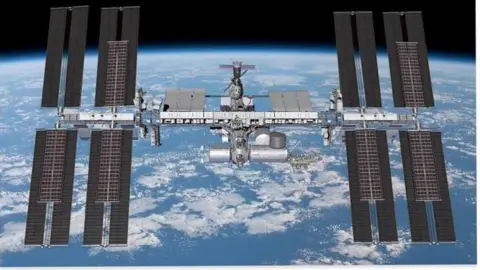
    NASA Image of International Space Station NASA

    The International Space Station has been continuously inhabited since the year 2000

    The incident is unprecedented in the history of the ISS, which has been permanently crewed for 26 years.

    Space missions have ended early due to health issues just twice before.

    In 1985, Soviet cosmonaut Vladimir Vasyutin and his colleagues returned four months ahead of schedule from a mission to the Salyut 7 space station due to a urological issue.

    And in 1987, a heart arrhythmia caused Soviet cosmonaut Aleksandr Laveykin to leave the Mir space station early.

    As more and more humans travel into space, including for tourism and a possible occupation of the Moon or even Mars, space experts say doctors will need to travel on missions.


    Source link