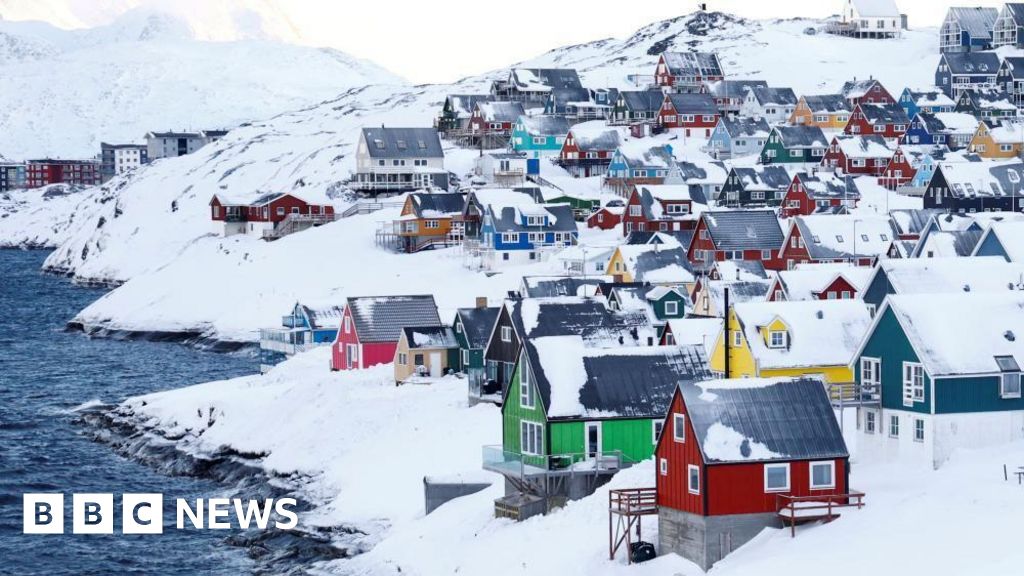
Denmark’s prime minister has told Donald Trump to “stop the threats” about taking over Greenland.
Mette Frederiksen said “it makes absolutely no sense to talk about the need for the United States to take over Greenland”, adding: “The US has no right to annex any of the three nations in the Danish kingdom”.
Her remarks come after Katie Miller – the wife of one of Trump’s aides, Stephen Miller – tweeted a map of Greenland in the colours of the American flag alongside the word “SOON”.
Trump has repeatedly raised the possibility of Greenland becoming an annexed part of the US, citing its strategic location and mineral wealth.
In her statement, posted on the Danish government website, Frederiksen said she was addressing the US “very directly”.
She said Denmark – “and thus Greenland” – was a Nato member and covered by the alliance’s security guarantee. Denmark already had a defence agreement with the US that gave it access to Greenland, she said, and Denmark had upped its investment in security in the Arctic region.
“I would therefore strongly urge the United States to stop the threats against a historically close ally and against another country and another people who have very clearly said that they are not for sale,” she said.
Earlier the Danish ambassador to the US responded to the post by Ms Miller – a right-wing podcaster and former aide to Trump during his first term – with a “friendly reminder” that the two countries were allies and saying Denmark expected respect for its territorial integrity.
The exchange comes after the US carried out a major military operation against Venezuela on Saturday, capturing its president Nicolas Maduro and his wife and removing them to New York.
Trump later said the US would “run” Venezuela and US oil companies would “start making money for the country”.
The US president has previously refused to rule out using force to secure control of Greenland, a vast island in the Arctic.
Trump has claimed that making it part of the United States would serve US security interests due to its strategic location and its abundance of minerals critical to high-tech sectors.
Greenland, which has a population of 57,000 people, has had extensive self-government since 1979, though defence and foreign policy remain in Danish hands.
While most Greenlanders favour eventual independence from Denmark, opinion polls show overwhelming opposition to becoming part of the US.
Vanessa BuschschlüterLatin America editor, BBC News Online
REUTERS/Leonardo Fernandez Viloria
Many of those who tuned in to US President Donald Trump’s news conference on Saturday were probably hoping to hear dramatic details of how US forces seized Venezuela’s leader, Nicolás Maduro, in a pre-dawn raid.
But arguably a more surprising moment came when Trump announced that now that Maduro was in custody, the US would “run” Venezuela “until such time as we can do a safe, proper and judicious transition”.
In another unexpected development, he added that Secretary of State Marco Rubio had been speaking to Maduro’s Vice-President, Delcy Rodríguez, who he said was “essentially willing to do what we think is necessary to make Venezuela great again”.
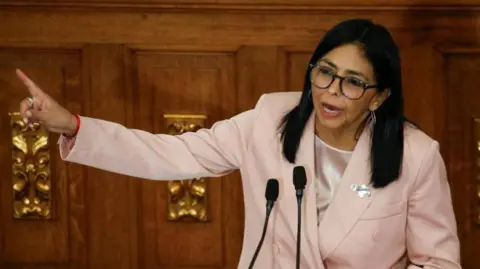
However, Rodríguez seemed less than co-operative in her own news conference later where she denounced Maduro’s detention as a kidnapping and stressed that Venezuela would not become a colony.
Given these conflicting messages, many are asking who is now in charge in Venezuela.
Under Venezuela constitution, it falls to the vice-president to take over should the president be absent.
So, on the face of it, the Venezuelan Supreme Court ruling that Delcy Rodríguez was the country’s acting president seems like a logical step.
But most Venezuela watchers had expected the immediate aftermath of a US intervention to look differently.
The US – and many other nations – did not recognise Nicolás Maduro as Venezuela’s legitimate president, having denounced the 2024 election as rigged.
Maduro was declared president by Venezuela’s electoral council (CNE), a body dominated by government loyalists.
But the CNE never produced the detailed voting tallies to back up their claim and copies of voting tallies collected by the opposition and reviewed by the Carter Center suggested that the opposition candidate, Edmundo González, had won by a landslide.
JUAN BARRETO/AFP via Getty Images
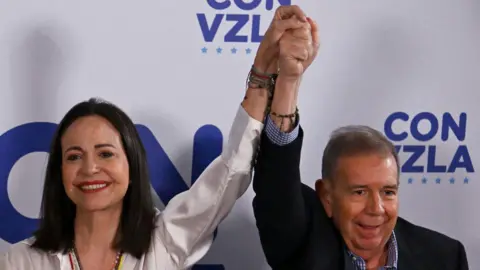
Edmundo González stood in for María Corina Machado after she was barred from running in the election
In view of that, the US and dozens of other countries recognised González as the president-elect.
González, a little-known former diplomat, had the backing of popular opposition leader María Corina Machado, whom he replaced on the ballot after she was barred from running for office by officials from the Maduro government.
With the security forces cracking down on the opposition in the aftermath of the election, González went into exile in Spain and Machado into hiding in Venezuela.
For the past 18 months, they have been urging Maduro to step down and lobbying for international support for their cause, especially from the US.
Machado’s profile was boosted by her winning the Nobel Peace Prize for “her struggle to achieve a just and peaceful transition from dictatorship to democracy” in Venezuela.
Following the publicity and recognition she received after embarking on a risky journey from her hiding place in Venezuela to Oslo to accept the award, many assumed that any post-Maduro scenario would see her returning to her homeland to take up the reins of power together with Edmundo González.
Machado herself posted a letter on social media following Maduro’s capture declaring that the “hour of freedom has arrived”.
“Today we are ready to enforce our mandate and take power,” she wrote.
But the US president stunned journalists when he declared that Machado did not have the “support or respect” to lead the country.
Trump said that his team had not spoken to Machado following the US strikes, but Marco Rubio had spoken to Delcy Rodríguez.
Trump’s next remark may provide the answer as to why the Trump administration is now Maduro’s loyal lieutenant – at least for now.
Trump quoted Rodríguez as saying “we’ll do whatever you want”, adding “she really doesn’t have a choice”.
Watch: The key questions on Trump’s actions on Venezuela
With Maduro’s inner circle still seemingly in power in Venezuela, US officials may have considered that the smoothest transition would be provided by having someone from the existing government take over.
In his news conference, President Trump said that the US was “ready to stage a second and much larger attack if we need to do so”, which appears to explain why he thinks that Delcy Rodríguez has no choice but to do the US’s bidding.
Gaby Oraa/Bloomberg via Getty Images
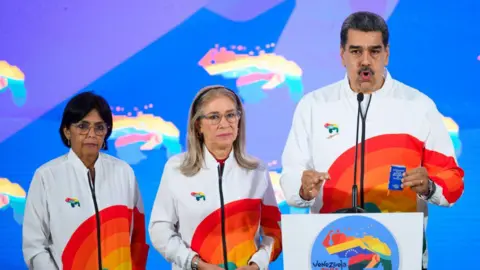
Delcy Rodríguez often appeared at events shoulder to shoulder with Nicolás Maduro and his wife, Cilia Flores
The fact that Rodríguez was seen surrounded by some of the most powerful men in Maduro’s inner circle hours after the president had been arrested and flown out of the country seems to suggest that she has won their backing, too.
Flanking her were her brother Jorge Rodríguez, who is the president of Venezuela’s National Assembly, Interior Minister Diosdado Cabello, Defence Minister Vladimir Padrino and the top commander of the armed forces, Domingo Hernández Lárez, among others.
This will have pleased US officials concerned that the capture of Maduro would lead to a potentially destabilising battle for control among his inner circle.
But the message Delcy Rodríguez had for the US would have been less pleasing to US ears.
She insisted that “there is only one president in Venezuela, and his name is Nicolás Maduro” and called his seizure “a kidnapping”.
“We will never again be a colony of any empire,” she insisted, promising to “defend” Venezuela.
While she certainly did not sound like the person Trump had described as “willing to do the US’s bidding”, there has been speculation that she may have struck a nationalistic note to keep Maduro’s most loyal supporters on board.
Quizzed about Trump’s support for Rodríguez and her remarks, Marco Rubio told CBS on Sunday that the US would make an assessment based on her actions, not her words.
“Do I know what decisions people are going to make? I don’t,” he added, seemingly implying that he was not as certain of Rodríguez’s willingness to work with the US as Trump.
What he was adamant about was the US’s willingness to pressure Rodríguez’s interim government.
“I do know this, that if they don’t make the right decisions, the United States will retain multiple levers of leverage to ensure that our interests are protected, and that includes the oil quarantine that’s in place, among other things,” he said.
In an interview with ABC, Rubio also appeared to suggest that fresh elections should be held in Venezuela.
“Government will come about through a period of transition and real elections, which they have not had,” he told This Week.
He also appealed for “realism”, suggesting that fresh elections would take time: “Everyone’s asking, why 24 hours after Nicolas Maduro was arrested, there isn’t an election scheduled for tomorrow? That’s absurd.”
Talk of fresh elections will no doubt disappoint not only María Corina Machado and Edmundo González but also many of the Venezuelans who voted for them and who have been adamant that they want to see those votes honoured.
The opposition has long insisted that free and fair elections are not possible while the key institutions involved in organising them are stacked with Maduro loyalists. A reform of those bodies will take time.
In the short term, therefore, Venezuela looks likely to be governed by Delcy Rodríguez and Maduro’s inner circle – as long as they meet the Trump administration’s expectations.
How long that may last will depend on whether Rodríguez can find a golden middle between accommodating Trump’s requests and the Maduro base interests.
She may soon find herself between a rock and a hard place.