Support justice-driven, accurate and transparent news — make a quick donation to Truthout today!
Physicist Ronald Koopman appeared at a Southern California Air District meeting in 2018 to talk about what seemed like an arcane scientific topic: hydrofluoric acid dispersion and water mitigation testing.
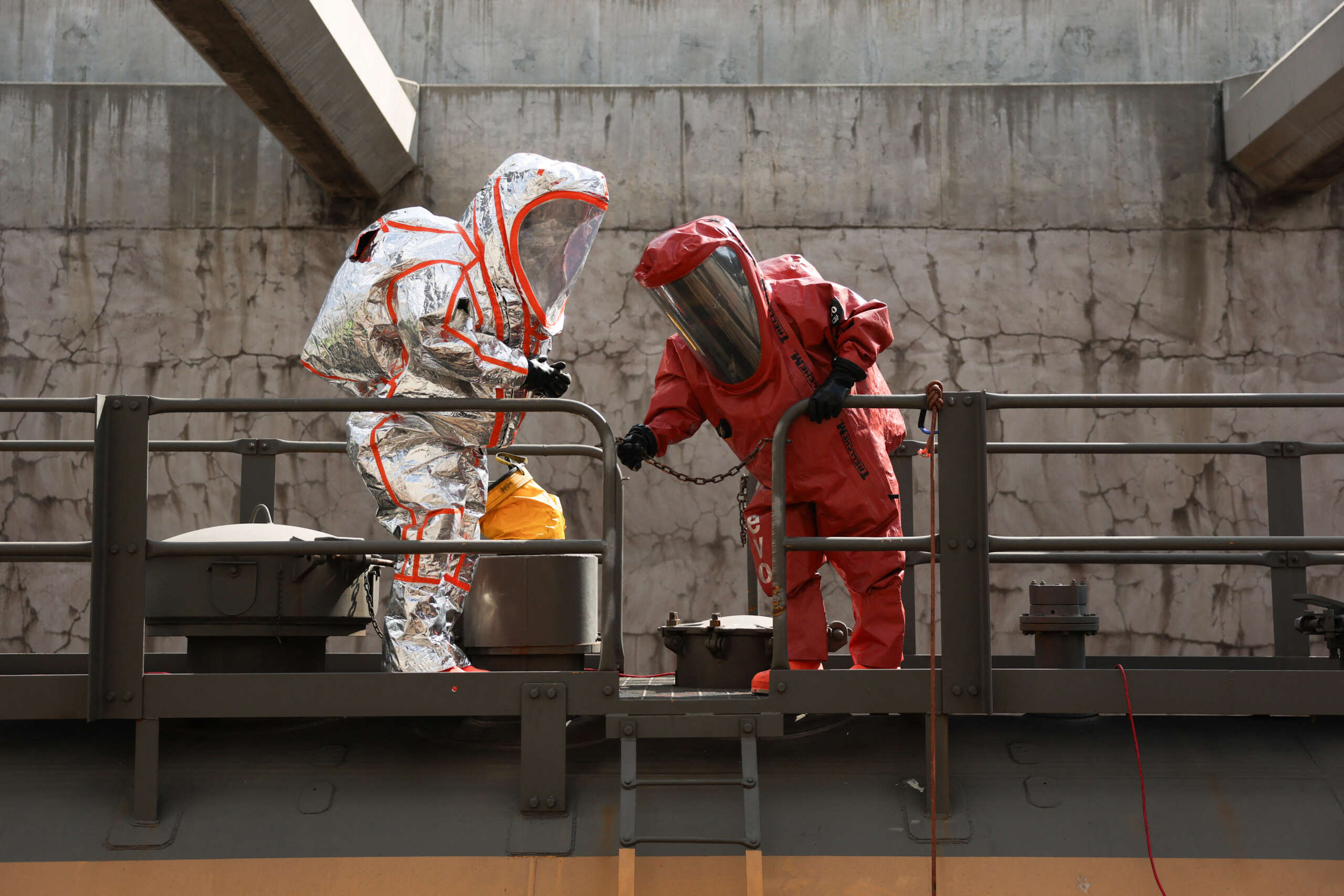
Hydrofluoric acid, also known as hydrogen fluoride or HF, is used to manufacture a range of materials, including refrigerants, gasoline, fluorine-based pesticides and fluoropolymers like those used to make Teflon. It’s also one of the most corrosive and dangerous chemicals known. Koopman conducted experiments with the chemical in the 1980s that warned about the potential of deadly accidents at facilities that use the hazardous materials.
With the Trump administration poised to roll back rules intended to protect workers and communities from catastrophic industrial chemical releases, and a new analysis showing rising rates of chemical accidents, Koopman’s presentation on highly hazardous materials has taken on a new urgency.
The number of accidents involving releases of dangerous chemicals rose by 57 percent between 2021 and 2025, from 83 to 131, according to an analysis released Monday by Public Employees for Environmental Responsibility, a nonprofit that works with former government officials.
Injuries or deaths from accidents also rose, from 60 to 89 over the same five-year period, the analysis found. Incident reports released by the Chemical Safety Board (CSB), an independent agency that investigates chemical accidents, show that more than 650 accidents occurred between April 2020 and May 2026, with 103 resulting in fatalities, 355 causing injuries and 314 doing “substantial property damage.”
Close to 150 million people live within 3 miles of these facilities. Historically underserved and overburdened populations, including people who identify as Black and Latino, are at greatest risk of exposure to an accidental release.
Many refineries were built before 1985, the analysis notes. “With each passing year the risk gets greater because the infrastructure continues to age,” said Jeff Ruch, senior counsel at PEER.
The 1980s HF experiments were run by Koopman, who now runs Hazard Analysis Consulting, on behalf of the oil company Amoco (later acquired by BP) to understand how the highly toxic refinery chemical would behave in a spill.
The test was a “spectacular success” in demonstrating what could happen and how serious the problem might be, Koopman said at the air district meeting. When they released 1,000 gallons of the noxious chemical, they expected it to pool on the ground and emit a small quantity of gas. Instead, a billowing “ground-hugging” mist formed, allowing the deadly gas to travel miles downwind, considerably farther than anyone thought possible.
Years later, after a series of fiery explosions at a hydrofluoric-acid unit at the Philadelphia Energy Solutions refinery rocked the surrounding South Philadelphia neighborhood in 2019, Koopman told NPR, “it’s just unconscionable” to allow people to live so close to these refineries.
The accident released more than 5,000 pounds of the chemical. The neighboring mostly Black and brown South Philadelphia neighborhood was spared thanks to “favorable wind conditions,” the CSB said.
“We had tried and failed to induce EPA to phase out hydrogen fluoride at these refineries,” said Ruch. “The refineries are near population centers, and the release of the gas could be just a horrible tragedy.”
Exposure to 170 parts per million of hydrogen fluoride for 10 minutes can cause death or serious injury.
After the massive Philadelphia refinery explosion, PEER petitioned the EPA to ban hydrogen fluoride in 2019. The agency refused to consider the petition.
Close to 50 refineries use hydrogen fluoride and have reported more than 200 accidents resulting in serious injuries and deaths to the EPA over the past 25 years, according to the nonprofit Public Health Watch. The refineries represent just a fraction of the 12,000 facilities that use certain hazardous substances and are regulated by the EPA’s Risk Management Program under the Clean Air Act.
The new statistics released by PEER were made public as a result of a lawsuit PEER and other groups filed to compel the Chemical Safety Board to disclose industrial chemical releases as required by the Clean Air Act. A federal judge ruled in 2019 that communities have a right to know what hazardous chemicals are released nearby.
Yet Trump’s EPA removed a public data tool designed to inform communities of nearby risks last year. President Trump has also tried to eliminate the Chemical Safety Board by withholding funding, though Congress has continued to fund the agency.
Earlier this year, the administration proposed to significantly weaken RMP rules finalized in 2024 “to reduce regulatory burden” and accepted public comment on the rules until early May.
The Biden administration’s strengthened RMP rules require a number of measures to reduce the risk of catastrophic accidents, including safer-alternatives analyses, independent analyses of accidents’ root causes, worker participation in accident-prevention plans and preparations to adapt to climate change.
An EPA spokesperson said the agency is reviewing public comments and continues to work toward completing the final rule in late 2026.
“EPA’s proposal relies on a rigorous analysis of RMP reportable incidents between 2014 and 2023, which shows accidental releases unequivocally declined significantly over that period,” the spokesperson said. “This means that RMP-regulated facilities had successful prevention programs in place before the Biden EPA finalized its nonsensical and burdensome 2024 rule.”
The Biden EPA used the same data and came to the opposite conclusion, said PEER’s Ruch. Plus, he added, “the conclusion that any decline is due to industry prevention plans is a supposition which the current EPA does not have the data to support.”
Meanwhile, chemical accidents resulting in evacuations, injuries or multiple casualties continue to happen at least once a week.
“With each passing year the risk gets greater because the infrastructure continues to age,” Ruch said. At the same time, he added, “the federal response to it is shrinking.”
Media that fights fascism
Truthout is funded almost entirely by readers — that’s why we can speak truth to power and cut against the mainstream narrative. But independent journalists at Truthout face mounting political repression under Trump.
We rely on your support to survive McCarthyist censorship. Please make a tax-deductible one-time or monthly donation.
Leave a Reply