On April 1, two months before Armenia’s parliamentary elections, Russian President Vladimir Putin invited Armenian Prime Minister Nikol Pashinyan to Moscow for bilateral talks. Their conversation made Putin visibly uncomfortable. The Russian president insisted that Armenia must choose between Russia’s Eurasian Economic Union and the European Union, arguing that Moscow’s experience with Ukraine demonstrated the impossibility of membership in both.
Pashinyan, who speaks fluent Russian, countered that Armenia’s membership in the Eurasian Economic Union remains fully compatible with deepening and diversifying relations with the European Union. As he put it, legally and administratively, this joint engagement with both blocs is real, and “it is a fact.” Putin repeatedly pressed that Armenia needs to make a geopolitical choice. Pashinyan responded by emphasizing Armenia’s commitment to maintaining strong ties with Russia while simultaneously expanding its relationships with other partners.
As Putin advanced what could be called the Kremlin’s false geopolitical binary, Pashinyan responded with a form of geopolitical jujitsu, highlighting mutual interest, underscoring legal dimensions of Armenia’s membership in Eurasian Economic Union, and leveraging his country’s continued participation in Russia-centric institutions. Pashinyan argued that a more stable and regionally integrated South Caucasus would ultimately strengthen Armenia-Russia relations as well.
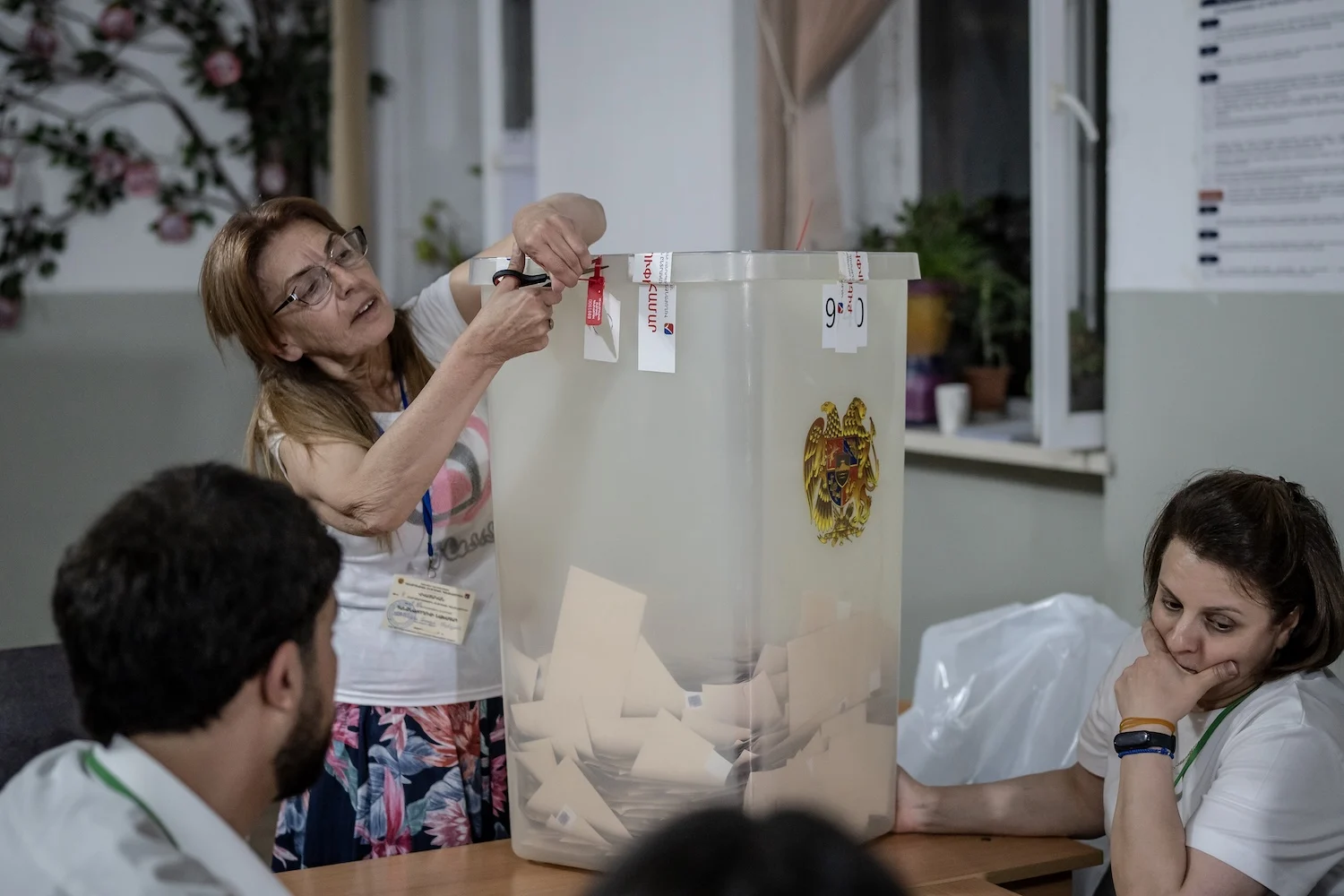
The meeting was a dramatic enactment of the clash between Putin’s wish to impose Russia on Armenia and Pashinyan’s efforts for “balanced and balancing” foreign policy for his country. Two months later, elections gave Pashinyan’s Civil Contract party a parliamentary majority. This denied the Russia-linked opposition a path to power.
While congratulations quickly arrived from abroad, Russia has yet to recognize the results. Instead, Russia-linked parties have challenged the outcome while hinting at mobilizing social unrest. When the Constitutional Court upheld the results earlier this month, five out of 18 political parties—two of which have cleared the electoral threshold to enter parliament—announced their intention to remove “the current regime” and begin “a new, more systematic, institutional and large-scale phase of political resistance.”
Pashinyan may have described the election outcome as “historic,” but Russia still succeeded in reasserting its stake over Armenia’s opposition and parliamentary integrity more broadly.
It is for this and other reasons that viewing the parliamentary election results merely as a geopolitical “pivot” away from Russia and toward the West—the dominant interpretation in global media—is an incomplete analysis. Though Armenia has thus far partially resisted Putin’s geopolitical binary, its elections were revealing as to how Russia continues to manage and control states in its periphery.
There are also learnings from Armenia’s story for other countries and contexts. Whereas democratic decline often stems from executive aggrandizement and attacks on the opposition, as in Hungary or Turkey, Armenia’s is a different pathway: A predatory opposition, fueled by external support, is gaining influence within the state. In a weakly institutionalized democracy with a thin party system, Armenia illustrates how such actors can undermine democratic accountability.
In many ways, Armenia’s challenge for strengthening representative politics in the post-Soviet neighborhood resembles those facing mature democracies.
In Armenia’s most recent election, the Kremlin utilized a variety of overt and covert measures to support political parties with links to Russia. These measures ranged from influence operations inside Armenia to electoral bribes and economic coercion.
But for Russia, it is always less about who will be elected, and more about how electoral politics and its aftermath will unfold. Maintaining pressure on state institutions before and after the elections has been the Kremlin’s goal all along. Fearmongering and polarization are among the broader toolkit that the Kremlin uses in Armenia as well as in other post-Soviet states, such as Georgia; Moldova; Kazakhstan; and, before Russia’s war there, Ukraine.
First, the strategy of polarization is carried out by supporting a politically unaccountable economic elite patronage network. In post-Soviet states, these networks emerged during the first few decades after the bloc’s collapse, bolstered by senior religious figures from these states.
Russia’s support for former authoritarian elites does more than influence elections. Rather than adapting to the new rules of democratic competition, old elites retain incentives to challenge institutions, delegitimize electoral outcomes, and obstruct the emergence of a credible opposition and work toward parliamentary integrity. The Russian support incentivizes them to challenge democratic institutions, which is why Armenian democracy lacks robust opposition politics.
Every new democracy must contend with the challenge of integrating old elites. According to studies by James Lexton, former ruling groups often reorganize as opposition parties, bringing with them entrenched economic interests and external linkages. Between 1974 and 2010, of the 65 countries that underwent democratization, 74 percent produced at least one prominent authoritarian successor party. Countries as diverse as Ghana, Hungary, Mexico, Poland, Paraguay, South Korea, and Tunisia have grappled with such quasi-oppositional forces. Authoritarian successor parties, in short, are the rule rather than the exception.
Nascent democracies in Russia’s neighborhood face the dual challenge of integrating illiberal political forces into democratic institutions while safeguarding the liberal principles on which those institutions rest. Compounding this, the behavior of former ruling elites is often shaped less by accountability to domestic electorates than by political and material incentives provided by Moscow.
The second strategy that the Russian state has been using in its external neighborhoods is to generate perennial insecurity, whether economic or strategic. Stephen Kotkin described and defined this strategy as the “perpetual geopolitics” of the Russian state. Russian “rescue narratives” long reinforced Moscow’s role as the Caucasus’s primary security broker.
However, the fall of Nagorno-Karabakh in 2023—despite the presence of Russian peacekeepers—and Azerbaijan’s attacks on Armenia’s internationally recognized borders in 2021 and 2022—to which the Russia-centric Collective Security Treaty Organization failed to respond—exposed the hollowness of Russia’s security guarantees.
In Armenia, the Kremlin has fueled anxiety over the Washington accords—signed between Armenia, Azerbaijan, and the United States last August—as well as U.S. support for road and railway connectivity via Armenia’s southern border. Russia’s fresh economic warfare on Armenia and threats to increase energy prices heighten these anxieties.
Armenia’s democratic vulnerabilities do not stem solely from Russia’s “perpetual geopolitics.” They are also shaped by the broader regional environment, particularly the incentives and constraints facing neighboring Azerbaijan’s highly personalized authoritarian system, where the logic of regional integration collides with the political imperatives of that regime.
Regional openness, now more possible following Armenia’s parliamentary elections, could help diversify Azerbaijan’s energy-dependent economy by boosting connectivity, investment, and global market access. Yet it also threatens the political insulation that underpins Azerbaijani President Ilham Aliyev’s rule by reducing state control over information, movement, and economic actors. Personalized autocracies often view trade less as a public good than as a tool of political control, making them wary of the pluralizing the effects of regional integration. Azerbaijan’s land borders remain closed since the 2020 Covid pandemic.
Such unresolved political challenges inside Azerbaijan elevate Baku’s value for the Kremlin. As Aliyev failed to sign the peace agreement that he and Pashinyan initialed in Washington in August, the door remains open for Baku-Kremlin authoritarian coordination to maintain insecurity as a perennial condition in the South Caucasus.
In addition to entrenched elites undermining institutions, Armenia’s experience reflects a broader crisis of political representation as parties increasingly lose both their effectiveness and their capacity to represent citizens.
Georgia’s democratic backsliding over the past decade demonstrates that a pro-Western geopolitical orientation is no guarantee of democratic consolidation. While Armenia remains focused on transforming the South Caucasus by advancing infrastructural connectivity and sustainable regional diplomacy, regionally untethered democratic transition such as that seen in Georgia ends up complicating the trajectories of democratic consolidation. Still, Georgia and Armenia demonstrate the continuing power of civic mobilization as a source of democratic resilience, particularly when formal political institutions lose their efficacy or outright attack the foundations of the state.
The Armenian case complicates broadly established democratic theories that rest on the push and pull between incumbent and opposition political parties as the main engine to drive the maturity and growth of representative democracies. The emergence of a functional, homegrown opposition is particularly difficult when authoritarian successor parties retain vast resources, entrenched patronage networks, and external support.
New strategies for safeguarding Armenia’s democratic trajectory, both from the Armenian government and its partners and friends on both sides of the Atlantic, are needed.
On the bright side, there is significant public trust in electoral politics, local levels of government, and the overall direction of where the country is headed, with 61 percent of Armenians surveyed in May expressing support for it. Trust in political institutions has also increased over the two past few years, and even the courts, traditionally lacking in public trust, have registered improvements. Armenia’s democratic system is largely stable, like a three-legged stool, but whether it can sustain the growing complexity of its increasingly digital economic system, and do so in Russia’s strategic shadow, is far from assured.
To address the problem of perpetual geopolitics in the South Caucasus, Armenia’s partners can elevate their work toward consolidating the peace process and reducing heightened insecurity. National security concerns have dropped as a primary issue, falling from 43 percent in December 2023 to 17 percent in May of this year, but the fragility of the peace process fuels support for illiberal opposition.
Armenia’s growing list of partners and allies needs to spend serious political capital to improve the security conditions in the South Caucasus, addressing Azerbaijan’s subtle obstruction of the peace process. The Armenian case reveals that serious investments in improving security conditions can help to legitimize democratic institutions and create political space to deepen the workings of representative democracy. In Moldova and Georgia, heightened insecurity and unresolved conflicts will continue to derail democratization.
Serious investments in the peace process would strengthen the legitimacy of Armenia’s governing institutions, a critical asset in managing Russia’s enduring pressure. Externally, providing economic dividends for Armenia’s democratic trajectory by supporting the peace process and advancing the regional modernization in the South Caucasus can go a long way in weakening support for illiberal political parties, sustained and nourished from the Kremlin. Internally, in the absence of credible parliamentary opposition, democratic resilience may depend on strengthening civic life beyond parliament.
This means new avenues and platforms of public debate, such as town halls in villages and municipal governments, and—especially for countries in Russia’s vicinity, considering the collapse of foreign aid from donor countries that have long sustained civil society—tax reforms to incentivize public support for civic groups.
Looking ahead, Russia’s pressure on Armenia is likely to intensify, ranging from economic coercion to efforts by its local proxies to foment social unrest. Yet each new attempt at coercion has also accelerated Armenia’s search for alternatives. Russian restrictions on Armenian agricultural exports, for example, prompted the European Union to extend tariff-free access for many Armenian products that had previously been destined for the Russian market. While EU membership is not on the horizon, the Kremlin’s persistent efforts to force Armenia into a geopolitical binary are likely to produce the opposite effect: economic partnerships, rapid tariff-free access to the unified market of the European Union, and a deeper diversification of Armenia’s foreign policy.
Between the agreement initialed in Washington, growing ties with Armenia, and the EU’s rapid response to Russia’s economic pressure, one lesson is clear: Strengthening regional environments and state capacity to deliver for citizens is essential. While Russia’s “pivot politics”—its forced and fabricated geopolitical binary—provided an important backdrop to Amenia’s recent election and certainly influenced voter considerations, domestic performance by politicians also mattered. The state’s ability to address socioeconomic concerns, including healthcare, pensions, infrastructure, rural development, and employment, shaped voter preferences.
That’s why democratic resilience depends on state capacity and everyday governance, regardless of whether opposition parties fulfill their role. Even in Russia’s geopoliticized peripheries, “all politics is local.”
Leave a Reply