Welcome to Foreign Policy’s South Asia Brief.
The highlights this week: Indian Prime Minister Narendra Modi and Chinese President Xi Jinping meet on the sidelines of the BRICS summit, Bangladesh faces the world’s worst measles outbreak as the death toll passes 1,000, and thousands of people remain missing after Nepal’s deadly floods.
Modi, Xi Meet on BRICS Sideline
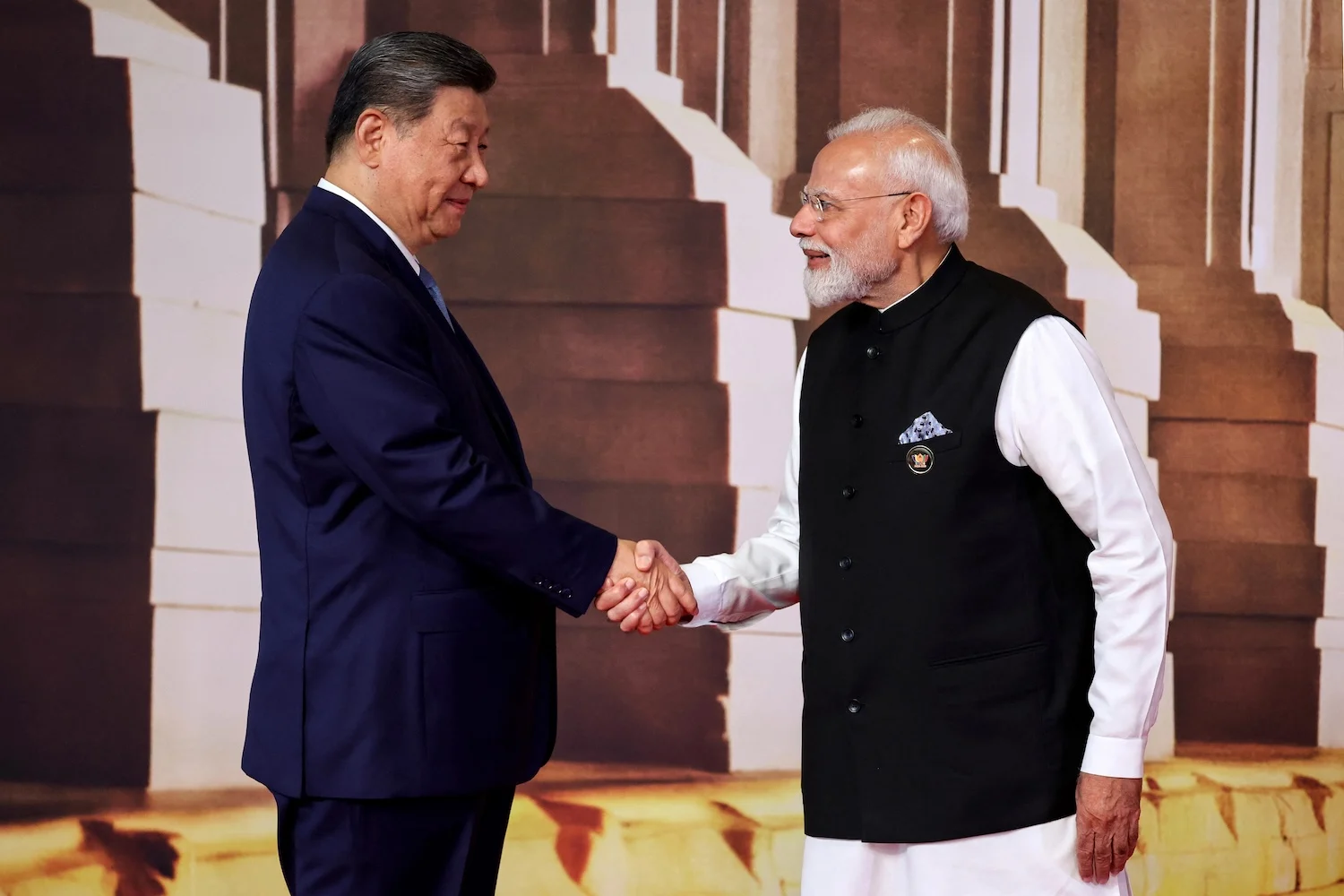
Over the weekend, Chinese President Xi Jinping traveled to India for the first time in seven years. Xi was in New Delhi for 24 hours to attend this year’s BRICS leaders’ summit, where he held a meeting with Indian Prime Minister Narendra Modi. An Indian Foreign Ministry statement said the two leaders pledged to strengthen commercial and cultural cooperation.
A more striking readout came from Chinese Foreign Minister Wang Yi, who said that the bilateral meeting covered long-term, strategic issues and that Modi and Xi reached “the most important consensus” to be partners, not rivals. Beijing hopes the meeting will advance bilateral ties “without stagnation or backsliding,” Wang added.
These are positive words for a relationship between major competitors—and one that was plunged into deep crisis after a deadly 2020 border clash in the Ladakh region. But an India-China rapprochement has been playing out for nearly two years. Xi’s visit marked the culmination, not the commencement, of India-China detente.
Still, the extent of the thaw shouldn’t be overstated. Historically, India-China ties have had their moments, with ample heady talk and good optics. Invariably, fresh tensions have spoiled them; the two are destined to remain rivals by history, geography, and geopolitics.
In October 2024, the post-Ladakh tensions began to ease with the inking of a new border agreement. India and China subsequently made pledges to resume direct air flights and bolster commercial cooperation. In March 2025, Modi said on a podcast that cooperation with China was “essential” for global stability.
Contrary to some commentary, the detente began before U.S. President Donald Trump was elected to a second term and wasn’t sparked by his policies. But Trump’s tariffs, which have hit both India and China hard, and concerns about access to U.S. markets gave both sides a strong incentive to accelerate their rapprochement and especially to deepen trade ties.
However, the reality is that continued India-China rivalry is all but inevitable. Both countries are both proud civilizational states and dispute claims to around 15,000 square miles of territory—equal to the size of Greece—along their shared border. They disagree on many other major issues, from Taiwan and Tibet to surveillance.
Perhaps most significantly, China is a close ally of India’s bitter rival Pakistan. Last year, the Pakistani military used Chinese weaponry in air combat operations against India for the first time.
Such challenges may seem surmountable, given what the India-China relationship has going for it. This includes their rock-solid trade partnership, shared interests, and considerable cooperation in global forums (including BRICS, but also the Shanghai Cooperation Organization and the Asian Infrastructure Investment Bank.)
Not surprisingly, India-China ties have often enjoyed periods of warmth—but ultimately a trigger, often a border provocation, has shattered that calm.
In 2017, a few years after Xi and Modi were photographed smiling on a swing together, a 73-day military standoff on the Doklam Plateau plunged relations into crisis. The Ladakh clash came just months after another Modi-Xi summit in India. Though border tensions have subsided, territorial disputes still fester and occasionally flare.
To be sure, there are plenty of reasons for New Delhi and Beijing to bury the hatchet. They want to ease tensions along their fraught border, create space for deeper commercial cooperation, hedge against Trump’s unpredictability, and remove a diplomatic headache from the BRICS grouping, which both capitals badly want to succeed.
Ultimately, however, so many divergences and sources of lingering mistrust preempt the possibility of full-on rapprochement. Though an extended period of cooperation is possible, it’s likely only a matter of time before the very “stagnation and backsliding” that Beijing says it wants to avoid.
What We’re Following
Bangladesh passes 1,000 measles deaths. More than 1,000 people in Bangladesh have now died from the measles virus since March 15, according to the latest government figures, released on Sept. 9. The country is suffering the world’s worst measles outbreak; it has logged thousands of new cases this year, including nearly 60,000 between January and June alone.
Nearly 20 million children have been vaccinated in Bangladesh since a new national inoculation campaign was launched in April. Health experts attribute the ongoing crisis to underestimations of how many children needed to be vaccinated—the target figure was 18 million, but experts say that a more accurate estimate is 22.6 million.
The number of measles vaccinations in Bangladesh—both first and second doses—fell between 2019 and 2023, and this year’s national campaign was the first since one from December 2020 to January 2021, during the disruptions of the COVID-19 pandemic. A sudden change of government in August 2024 caused further vaccine interruptions.
The current government, which took office in February, is working hard to ease the crisis. But it must grapple with not only the large number of children who still need to be vaccinated, but also economic stress and energy shortages that further complicate inoculation efforts.
Thousands still missing in Nepal. Three weeks after a glacial collapse precipitated catastrophic floods in Nepal, more than 5,000 people remain missing. Authorities say they continue to search and are trying to provide information to families as soon as possible. But massive destruction—including 2.2 million tons of—has made search and rescue difficult.
Authorities are now transitioning from search and rescue to relief and reconstruction efforts, with an eye toward the large number of people who lost their homes. The disaster leveled entire villages, submerged tunnels, and swept away hydropower facilities. Damage to roads and bridges has created additional complications.
Nepal’s government said that the total estimated cost for reconstruction efforts will be $4.8 billion—around one-tenth of the country’s total nominal GDP.
Sri Lanka signs labor accords with Thailand. This week, Sri Lanka and Thailand signed agreements to enable 10,000 Sri Lankans to work in the Southeast Asian country, with a focus on young workers and sectors including information technology and tourism. The Sri Lankan workers will receive equal rights and protections under Thai labor laws.
The agreements address a key need for both countries: Thailand has a labor shortage, and Sri Lanka is looking to tap into a wider array of foreign labor markets. But the deal goes against a common pattern in Sri Lanka—and elsewhere in South Asia—in which young people go to the Middle East, Europe, or the United States for work.
There appears to be a cultural factor at play. The Sri Lankan government believes cultural similarities between Sri Lanka and Southeast Asia will make for a smoother adjustment process—putting them in a strong position to be productive and send home remittances that are critical for the Sri Lankan economy.
FP’s Most Read This Week
How to Survive in a World Without Rules by Hal Brands
Top Signs You’re Heading for a Quagmire by Stephen M. Walt
The World’s Only Real Hope of Maintaining Order by Charles A. Kupchan
Under the Radar
Last week, Pakistan’s Foreign Ministry said that it was not contemplating the use of military force against Iran-backed Houthi rebels in the Middle East.
The statement came in response to speculation, fueled by a Turkish news report, that Pakistan was considering invoking the Mecca Agreement—the new mutual defense pact among Pakistan, Saudi Arabia, and Turkey—and joining a military operation with the Saudis against the Houthis. Houthi attacks against Saudi targets have escalated in recent days.
Pakistan’s statement gives ammunition to critics of the Mecca Agreement—as well as a similar bilateral deal between Islamabad and Riyadh—who dismiss the accord as a paper tiger.
In the last year, Taliban military operations have hit Pakistan has been hit multiple times; Saudi Arabia has been assaulted by the Houthis as well as direct Iranian strikes. At no time has Pakistan or Saudi Arabia intervened militarily to assist the other, though Pakistan has sent some arms and troops to Saudi Arabia in recent weeks.
Still, the two mutual defense pacts are mainly meant to focus on deterrence, which the signatories say the United States cannot provide sufficiently in the Middle East. In Pakistan’s case, the accords are meant to help advance key foreign-policy priorities, including playing a larger role in the security architecture of the region.
Leave a Reply