Welcome back to World Brief, where we’re looking at a massive Board of Peace recovery plan for Gaza, Iran defying U.S. threats of annihilation, and calls for global safeguards on AI development.
A ‘Spectacle That Should Shame Us All’
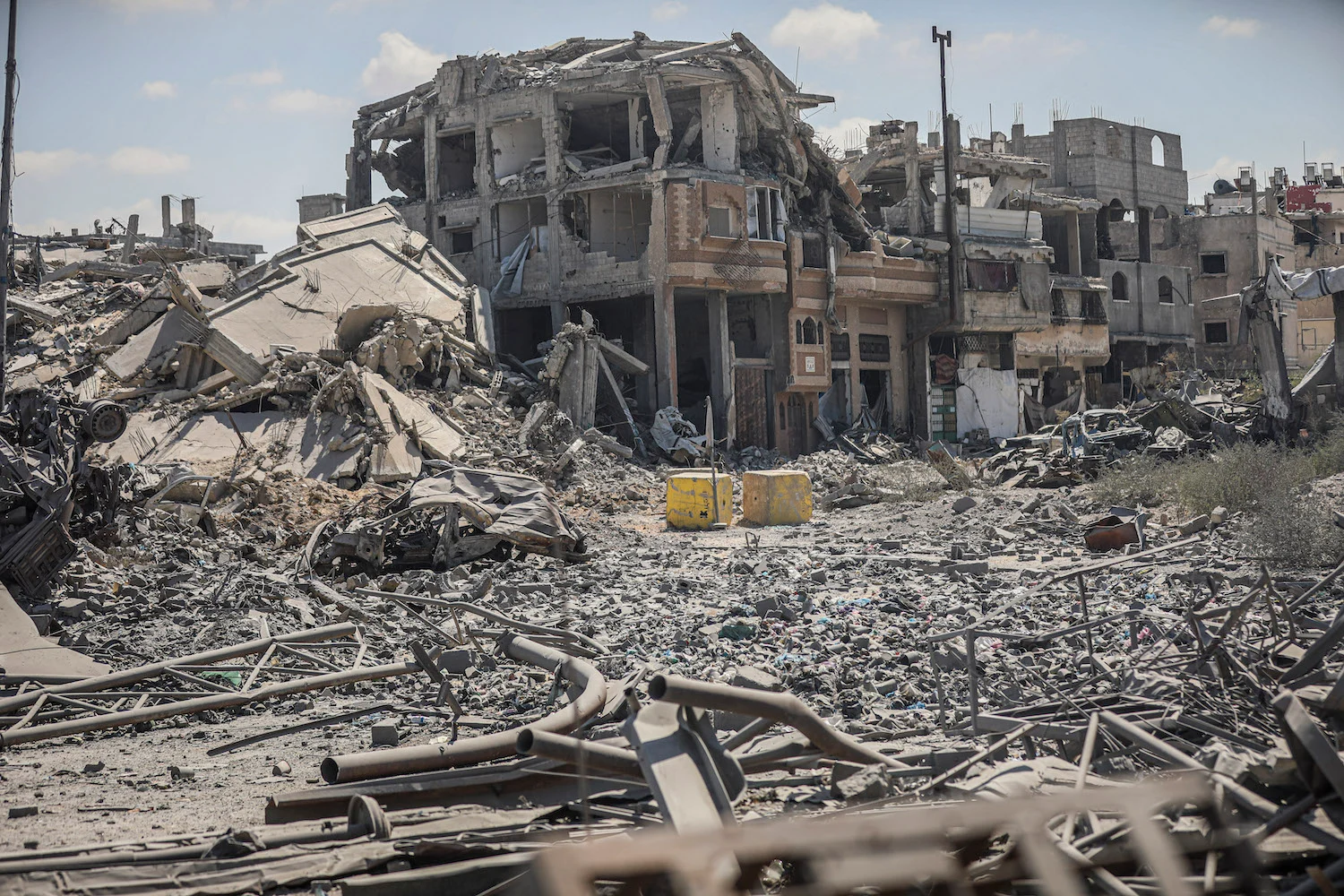
The U.S.-led Board of Peace unveiled a $2.45 billion plan on Wednesday for the reconstruction and governance of Gaza. While acknowledging that enormous hurdles continue to stand in the way of progress, the board outlined a lightning-fast, six-month proposal that includes debris removal, temporary housing, hospital reconstruction, electricity and water restoration, and the deployment of a multinational security force.
Welcome back to World Brief, where we’re looking at a massive Board of Peace recovery plan for Gaza, Iran defying U.S. threats of annihilation, and calls for global safeguards on AI development.
A ‘Spectacle That Should Shame Us All’
The U.S.-led Board of Peace unveiled a $2.45 billion plan on Wednesday for the reconstruction and governance of Gaza. While acknowledging that enormous hurdles continue to stand in the way of progress, the board outlined a lightning-fast, six-month proposal that includes debris removal, temporary housing, hospital reconstruction, electricity and water restoration, and the deployment of a multinational security force.
“The plan shows how to stand up a government from nothing, an economy from shambles, and a territory from disaster,” a Board of Peace official told Axios.
The 66-project blueprint is designed to support U.S. President Donald Trump’s 20-point peace plan for Gaza. Trump has consistently pointed to that proposal as evidence that he “ended” the nearly 3-year-long war.
However, the bedrock of that plan—a U.S.-brokered cease-fire that took effect last October—remains precarious at best. Bouts of fighting continue to wreak havoc on the enclave; on Wednesday, Israeli airstrikes killed at least four people, one of whom Israeli Prime Minister Benjamin Netanyahu claimed was a senior Hamas financial official. The Israeli military still refuses to withdraw from large swaths of Gaza territory, Hamas has resisted efforts to give up its armaments, and the vast majority of Gaza’s residents continue to live in makeshift tent camps or destroyed homes.
According to the U.N. humanitarian affairs office, Gaza remains plagued by overcrowding, poor shelter, and unsafe drinking water. Palestinian women face growing pressures, as they now head nearly one in every four households due to their husbands being killed, detained, injured, or missing. And although the October cease-fire allowed some humanitarian aid to enter Gaza, chronic malnutrition continues to affect 12.2 percent of children under age 5.
The Board of Peace’s latest blueprint only scratches the surface of what experts estimate Gaza needs to rebuild. The board acknowledged on Wednesday that full reconstruction will cost around $35.2 billion over the medium term and another $71.4 billion over the next 10 years.
“Obviously this is a long-term project,” U.S. Secretary of State Marco Rubio said. “It’s not something that can happen in six months. But at least [this] gives people a hope. Here’s the future that awaits you if everyone does their part.”
But not everyone believes that the White House can lead the charge. French President Emmanuel Macron used his time on the United Nations’ stage on Tuesday to dismiss Trump’s claims that he has brought peace to Gaza. “Some boast of a supposed peace, but that peace has not reopened humanitarian access for a single second,” Macron said in thinly veiled remarks about the Trump administration. “Are we simply to stand by and watch this spectacle that should shame us all?”
Today’s Most Read
What We’re Following
Pezeshkian’s rebuttal. Iranian President Masoud Pezeshkian delivered a defiant speech at the U.N. General Assembly on Wednesday, vowing to never surrender to the United States. It came just 24 hours after Trump threatened to “annihilate” the Islamic Republic. His comments contradict the U.S. president’s claims that Tehran desperately seeks a peace deal, and they show that Pezeshkian will not be cowed by the White House’s warnings.
Pezeshkian’s presence was historic; no other leader has ever attended the U.N. General Assembly in New York in person while their country was at active war with the United States. During his address, Pezeshkian also introduced a potential new flash point to the conflict, warning that Iran will target its Gulf neighbors if they abide by new U.S. secondary sanctions. These sanctions, imposed on Wednesday, aim to punish foreign companies that continue to provide refueling or other services to civilian Iranian aircraft.
Meanwhile, Trump’s chief envoys to the conflict, Steve Witkoff and Jared Kushner, held indirect talks with Iranian officials on Tuesday. The details of their dialogue are unclear, though Trump described the conversations as “very good,” and Witkoff wrote that he hopes they prove to be “constructive and promising.” Tehran did not comment on the talks.
The threat of AI. Top executives from three leading artificial intelligence companies briefed the U.N. Security Council on Wednesday. OpenAI CEO Sam Altman, Anthropic CEO Dario Amodei, and Hugging Face CEO Clément Delangue discussed the future of AI advancement, including the risks that uncontrolled AI poses to international security. During the meeting, Altman urged Security Council members to adopt benchmarks that assess safeguards and measure AI’s capabilities—in line with an industry-wide push for a pause or slowdown in development.
All eyes are now on the council’s two superpowers, China and the United States, whose leaders are set to meet at the White House on Thursday. Beijing and Washington lead the world in AI development, and the technology is expected to be high on the agenda for Trump’s summit with Chinese President Xi Jinping.
Cooperation between China and the United States, including exchanges of information and better transparency, would set the tone for how the rest of the world should address these concerns. However, getting the long-time rivals to agree on how to regulate AI is unlikely, as FP’s James Palmer has written. Trump rejected “any attempt to construct a globalist scheme to control” AI during his address to the U.N. General Assembly on Tuesday, saying, “I’m not going to stifle growth of something that will be bigger than the Industrial Revolution.” Meanwhile, Chinese AI firms DeepSeek and Moonshot similarly appeared hesitant to pull back; both companies declined invitations to join Wednesday’s Security Council briefing.
To the ballot boxes. Morocco kicked off parliamentary elections on Wednesday, with candidates from 27 parties competing for 395 seats in the lower house of parliament. According to the Moroccan Institute for Policy Analysis, Rabat is unlikely to see a major shift in power, as the two front-runners—the National Rally of Independents (RNI) and the Authenticity and Modernity Party (PAM)—have been part of the country’s governing bloc since 2021. Still, a major migration crisis, coalition infighting, and domestic unrest could spark a possible comeback for the Islamist Justice and Development Party (PJD).
Last year, youth-led anti-government protests erupted across more than a dozen Moroccan cities. Demonstrators criticized Rabat for investing $5 billion in infrastructure for the 2030 FIFA Men’s World Cup when critical public services, such as schools and hospitals, were crumbling. Faith in Morocco’s leadership further deteriorated in late July, when around 80,000 migrants surged across the country’s border into the Spanish exclave of Ceuta, resulting in at least 100 deaths.
Disillusionment with Rabat’s current power balance as well as a growing rift between the RNI and PAM, which have accused each other of stealing members, could ultimately help the PJD regain traction. Among the Islamist party’s top priorities are fighting state corruption and providing greater support for Gaza; the party opposed Morocco’s decision in 2020 to normalize relations with Israel.
Initial election results are expected on Thursday.
Odds and Ends
U.N. General Assembly speeches are an opportunity each year for world leaders to shed light on their biggest global concerns and lay out their foreign-policy agendas. But for the country of Nauru, Tuesday’s address focused on something a little closer to home. President David Adeang called on U.N. members to recognize the nation’s new name, Naoero, which he maintains better encompasses the South Pacific island’s rich heritage.
“We do not make this choice to erase our past; we make it because we honor it,” Adeang said. “That name carries the memory of our ancestors, our language, and our identity. It has been there all along. Never lost, never absent. Today, we restore Naoero.”
Leave a Reply