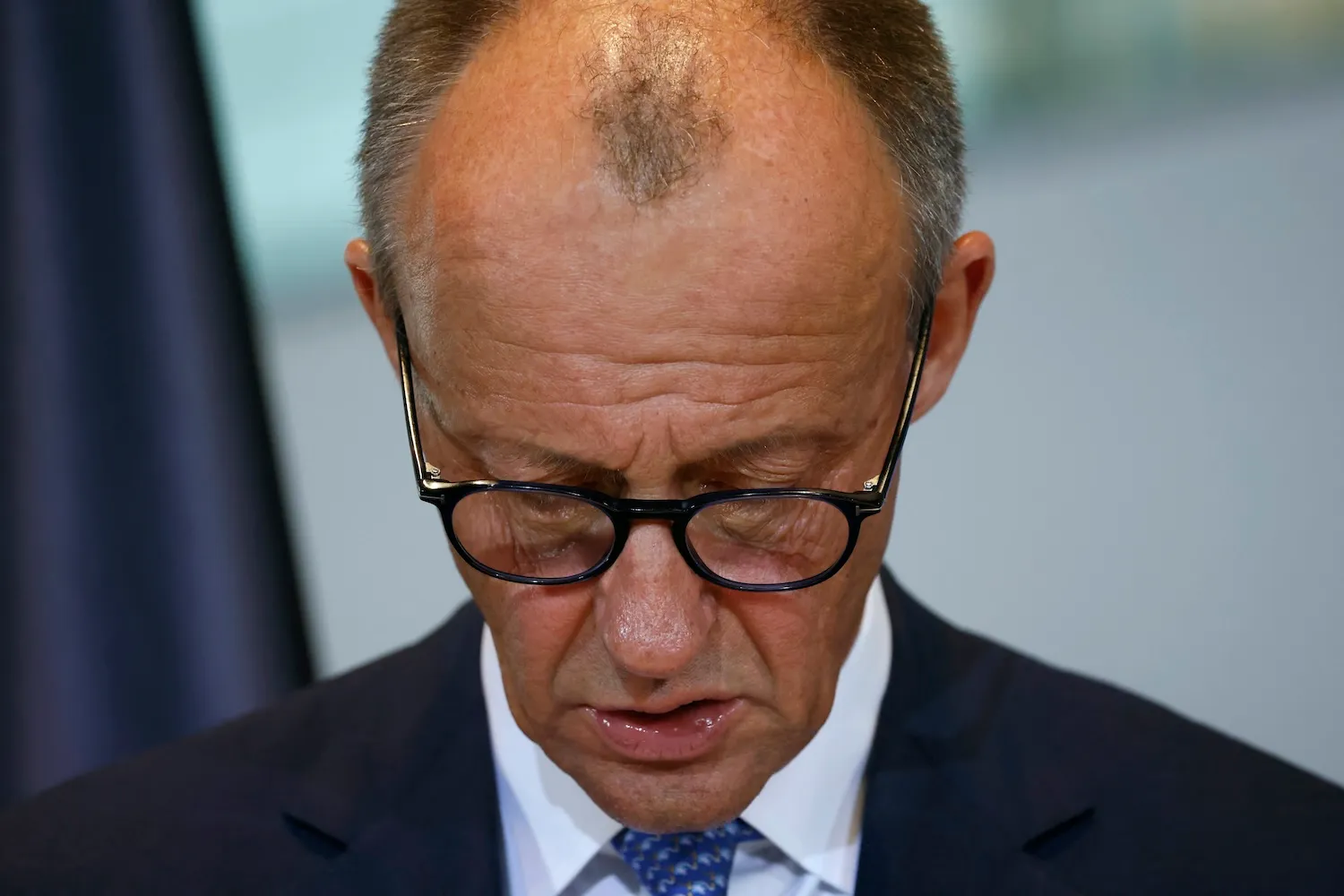
“Disaster.” German Chancellor Friedrich Merz was not mincing words Sunday night when he described the results of the state elections for his center-right Christian Democratic Union (CDU) party. The CDU fell below the 5 percent threshold in the east German state of Mecklenburg-Vorpommern—the first time in postwar German history that the CDU has failed to win representation in a state election. The far-right Alternative for Germany party (AfD) finished first in Mecklenburg-Vorpommern with 38 percent, the second time that it has notched a first-place finish in September after garnering nearly 44 percent of the vote in the east German state of Saxony-Anhalt. Elections in the city-state of Berlin were no less dramatic, with the Left party (the successor to the East German communist party) finishing first, well ahead of Merz’s CDU.
That the CDU would lose badly in September was clear for some time, as was the chancellor’s deep unpopularity: In a recent poll, 84 percent of Germans said that they were unhappy with the performance of Merz’s government. That has fed speculation that Merz could be toppled from within or resign the party chairmanship to save his position, at least for a time, as chancellor.
“Disaster.” German Chancellor Friedrich Merz was not mincing words Sunday night when he described the results of the state elections for his center-right Christian Democratic Union (CDU) party. The CDU fell below the 5 percent threshold in the east German state of Mecklenburg-Vorpommern—the first time in postwar German history that the CDU has failed to win representation in a state election. The far-right Alternative for Germany party (AfD) finished first in Mecklenburg-Vorpommern with 38 percent, the second time that it has notched a first-place finish in September after garnering nearly 44 percent of the vote in the east German state of Saxony-Anhalt. Elections in the city-state of Berlin were no less dramatic, with the Left party (the successor to the East German communist party) finishing first, well ahead of Merz’s CDU.
That the CDU would lose badly in September was clear for some time, as was the chancellor’s deep unpopularity: In a recent poll, 84 percent of Germans said that they were unhappy with the performance of Merz’s government. That has fed speculation that Merz could be toppled from within or resign the party chairmanship to save his position, at least for a time, as chancellor.
He is also facing the dilemma of addressing demands for fundamental reforms while facing conflicting pressure on how to do so, with most of his Bundestag caucus and some western state party leaders seeking to move faster and further, while east German state leaders and those from the “centrist” wing seek to backtrack on policies such as pension reforms that were heavily criticized when they were proposed this summer.
None of that has happened, for now at least. The state leaders from the CDU supported Merz last week, but their joint statement focused on avoiding instability and rejecting a leadership change, without mentioning Merz by name. The chancellor made a statement just after the polls closed on Sunday evening—when the party still looked likely to enter the Mecklenburg-Vorpommern legislature—that underscored his commitment to carrying out the government’s reform program despite the sacrifices that it would require.
He reiterated that pledge on Sept. 21, adding that he would remain chancellor as well as CDU chairman. It was in part the scope of the disaster that may have allowed Merz to hold on to office: His rivals recognize that to displace him would mean that they would have to take responsibility for the bitter medicine that Germany needs. The severity of Germany’s situation and his government’s unpopularity is thus Merz’s short-term political insurance policy.
Merz may have temporarily avoided a challenge to his chancellorship, but that is subplot in the larger story: the ebbing of Merz’s power, and the fact that there is no viable alternative to the current CDU-led coalition with a junior Social Democratic Party (SPD).
Overall, the decline in the two once-major parties and the recent history of ever weaker “grand coalitions” between the CDU and Social Democrats have robbed the system of a clear alternation in power. It has also left the CDU as the only viable force in German politics to lead a government. The previous virtue of Germany’s postwar party system—in which the alternation between left-of-center and right-of-center coalitions provided a high degree of stability and resistance to rapid swings driven by shifting public sentiment—is gone. The situation also highlights the inability of the established German parties to develop and promote rising leaders whose strength is connecting with voters rather than navigating hierarchical party structures.
That may be interesting for Germany specialists, perhaps. It also has major implications for the future of European politics and defense, as well as for the political direction of the country and its leadership role in Europe.
Merz has now staked his political leadership and legacy on a thorny domestic reform agenda. In the 19 months since the last Bundestag election, Merz had devoted significant effort to Germany’s rearmament, managing relations with the United States, and expanding German and European support to Ukraine after U.S. financial assistance and arms provisions largely ended early in the second Trump administration. Merz criticized Germany’s overly normative foreign policy and the neglect of the capabilities needed to pursue and defend the country’s interests.
He identified, at this year’s Munich Security Conference, a goal for a new German strategy and method to achieve it: “Leadership in a spirit of partnership, yes; hegemonic fantasies, no. Never again will we Germans go it alone. That is the abiding lesson from our history. We are asserting our freedom with our neighbors—and only with our neighbors, our allies and our partners. We are building on our strength, our sovereignty, and our capacity for mutual solidarity in Europe.”
Merz has recognized that Germany’s neighbors rely on it to provide the backbone in the strengthening of Europe’s military capabilities and the organizing of effective coalitions. Although he has not articulated a comprehensive strategic approach to European and global security, Merz’s investment in flexible institution-agnostic formats—such as the E3 (Germany, France and the United Kingdom), E5 (the E3 plus Italy and Poland), the Nordic-Baltic 8 (Denmark, Estonia, Finland, Iceland, Latvia, Lithuania, Norway, and Sweden), and most recently the European Arctic Summit—helped build the consultative mechanisms that will be crucial as the United States under the Trump administration plays less of a role in managing European security.
For a second time in a row, Merz has had to cancel his planned trip to the United Nations General Assembly leaders’ week in order to manage problems at home. In 2025, he stayed in Berlin to shepherd his budget, while this year he is staying at home to deal with the political mess emerging from the Sept. 20 state elections. A narrowing bandwidth for international initiatives is inevitable if the chancellor makes national economic and social policy renewal his focus.
The choice is understandable, and hard to argue against. A consequence is that it will diminish Merz’s ability to shape and lead the European reaction to a deteriorating situation. Merz and the national leadership of the SPD have not wavered in their support for Ukraine, but the SPD’s one success story of the fall, Mecklenburg-Vorpommern Minister-President Manuela Schwesig highlighted a growing tension. Schwesig, who trailed the AfD earlier in the year by as much as 14 points and staged an impressive comeback to 35 percent, enabling her to form a government, has said that Germany’s support for Ukraine cost the party votes. (She also ran on opposition to Merz’s proposed reform of the pension system, which does not bode well for the fundamental reforms that Germany needs.)
The AfD and others implied that German assistance to Ukraine meant that social spending at home was suffering. This will become a battleground for foreseeable future, because 2027 will see elections in five western states. This month’s elections represented 9 percent of Germany’s total population; next year, around 37 percent of the population will be called to vote, raising the stakes enormously.
This month’s elections have blown a hole in the post-unification political model in the eastern German states, which have transformed from a broad span of political parties that offered multiple coalition possibilities. A de facto two-party system is emerging: the AfD and whichever one of the mainstream parties has a leader with some combination of local credibility and charisma. The tender nature of parliamentary democracy in the east and the lack of deeply held party identification have accentuated this process. West German states have not been affected in the same way yet, but the long-term trend of eroding party loyalty and social change that underly the shift are no different there.
Restoring Germany’s economic fundamentals and reforming its social welfare systems are generational tasks, to which one could add retooling the established parties to connect the issues and social patterns in ways that bring success in modern election campaigns. Friedrich Merz now has his work cut out for him, with new urgency. How Germany’s partners adapt will be crucial for Europe’s ability to defend its shared interests.
Leave a Reply