Hugo BachegaMiddle East correspondent, Beirut

 AFP
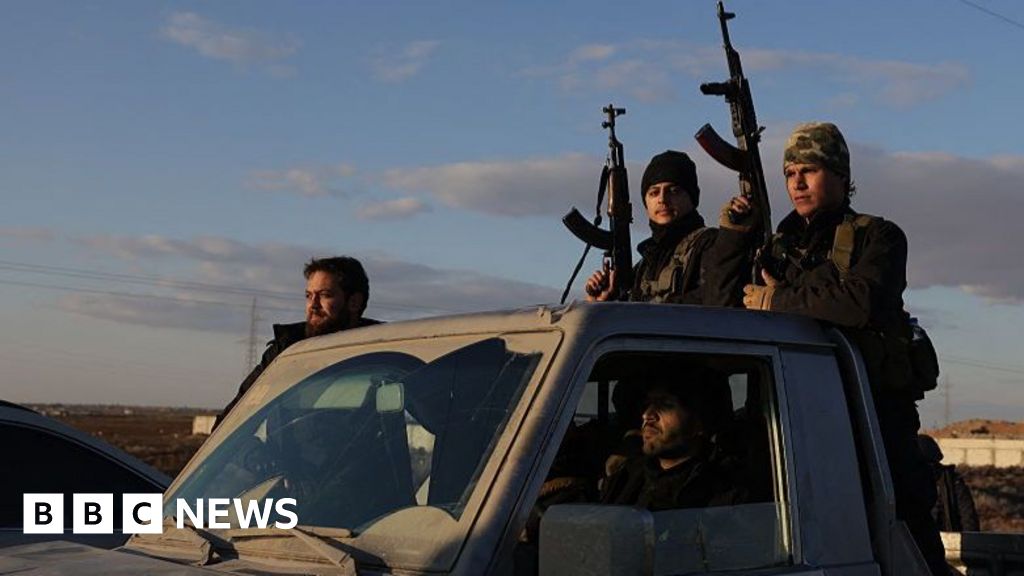
AFPPresident Ahmed al-Sharaa has made significant advances in his efforts to unify a deeply fractured Syria, reclaiming large swathes of territory in the north-east that had been under the control of a Kurdish-led militia alliance for more than a decade. What happens next will be a test for a government that has tried to assert its authority over the whole country.
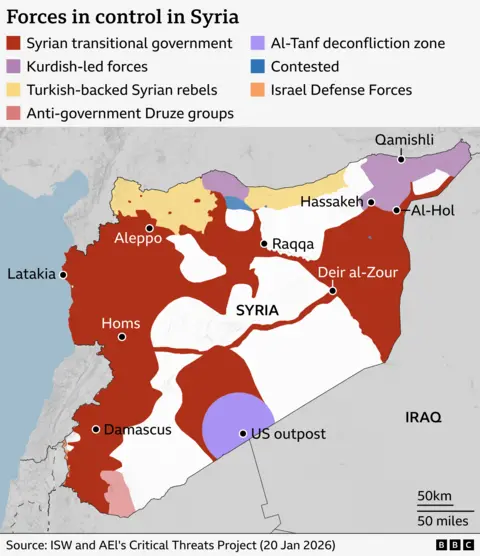
The gains by government forces in a lightning offensive against the Syrian Democratic Forces (SDF) marked the biggest change of control in Syria since Islamist-led rebels toppled Bashar al-Assad in December 2024, ending the 13-year civil war. Before this month’s push, nearly a third of Syria’s territory was controlled by the Kurds, who enjoyed American support after helping a US-led coalition defeat the jihadist group Islamic State (IS) in the last decade. There, they ran an enclave with its own government and institutions, with the SDF being its military arm.
 EPA
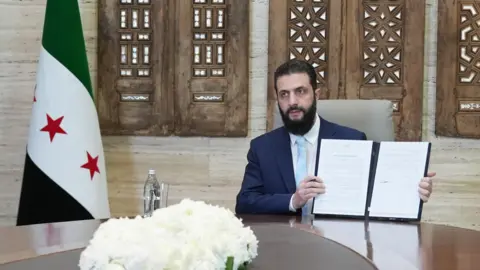
EPAThe offensive came amid stalled talks between Sharaa’s government and the SDF about the key issue of integrating its forces into the country’s institutions. A deal was signed last March, but a year-end deadline expired with little progress as the SDF remained reluctant to give up its autonomy. The militia alliance, analysts say, miscalculated in its negotiations with the government, seeming to believe it would have the backing of its longtime ally.
But the US under President Donald Trump has strongly supported Sharaa, who has defended his vision of a united Syria under the control of Damascus. Trump hosted Sharaa, who was once branded a terrorist by the US for his former links to al-Qaeda, at the White House last year, and lifted devastating sanctions imposed on Syria in the Assad years. When Sharaa’s forces started their push, there was no apparent US objection.
 AFP
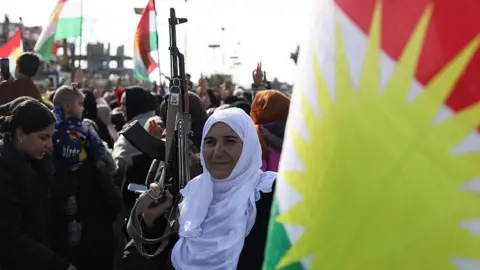
AFPOn Sunday, after suffering stunning territorial losses, the SDF agreed on a 14-point deal that reversed almost all concessions it had gained from the government in earlier negotiations. Crucially, its members are expected to join the Syrian army and interior ministry as individuals – and not as separate units, as it had demanded – while the control of oil and gas fields, important for Syria’s economic recovery, will be transferred to the government. SDF-run prisons and camps holding thousands of IS detainees and family members are also being brought under Damascus’ control.
The announcement came days after Sharaa issued a decree that was seen as an attempt to reach out to the Kurds, whose rights had been denied in the five-decade rule by the Assads: it designated Kurdish as a national language, granted Syrian nationality to stateless Kurds, and declared the Nowruz – the Persian new year – a national holiday.
Fighting, however, erupted again. So far, the areas reclaimed by government forces have been mainly Arab, where locals had resentments against the SDF. But the troops continued to move towards Kurdish-majority areas, raising the prospect of deadly clashes, and reportedly angering Washington. On Tuesday, Sharaa’s government suddenly announced a ceasefire, giving the SDF four days to present a detailed plan for the integration of areas under its control into the state. This halted the move of his army and prevented the escalation of the violence, for now.
 EPA
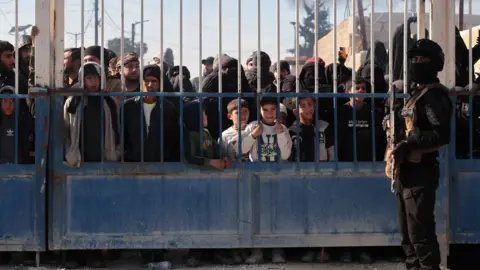
EPASince coming to power after the fall of the Assad regime, Sharaa has repeatedly vowed to protect Syria’s minorities. But the country has seen deadly bouts of sectarian violence. Last year, government forces were accused of atrocities after being sent to the Mediterranean coast, which is the heartland of Assad’s Alawite sect, and the mainly Druze southern province of Suweida. Kurds fear the same could happen to them, despite renewed guarantees offered by Sharaa.
For the Kurds, the losses are a fatal blow to the aspirations of preserving their autonomy, with the US position being seen as a betrayal. Tom Barrack, the US special envoy, said the “original purpose” of the partnership with the SDF, as the main anti-IS force in Syria, had “largely expired”, and that the “greatest opportunity for the Kurds in Syria” lay in the transition under Sharaa, whose government is seen by Western countries as the best chance to guarantee Syria’s stability.
The dramatic changes empower Sharaa but are likely to renew calls for him to decentralise authority, with critics saying key posts have been limited to his allies. It could also indicate what he may be planning to do in other areas of the country, including those held by the Druze, who demand autonomy.
Leave a Reply