
Category: Uncategorized

  • More than 2,000 people reported killed as Trump says ‘help is on its way’

    More than 2,000 people reported killed as Trump says ‘help is on its way’


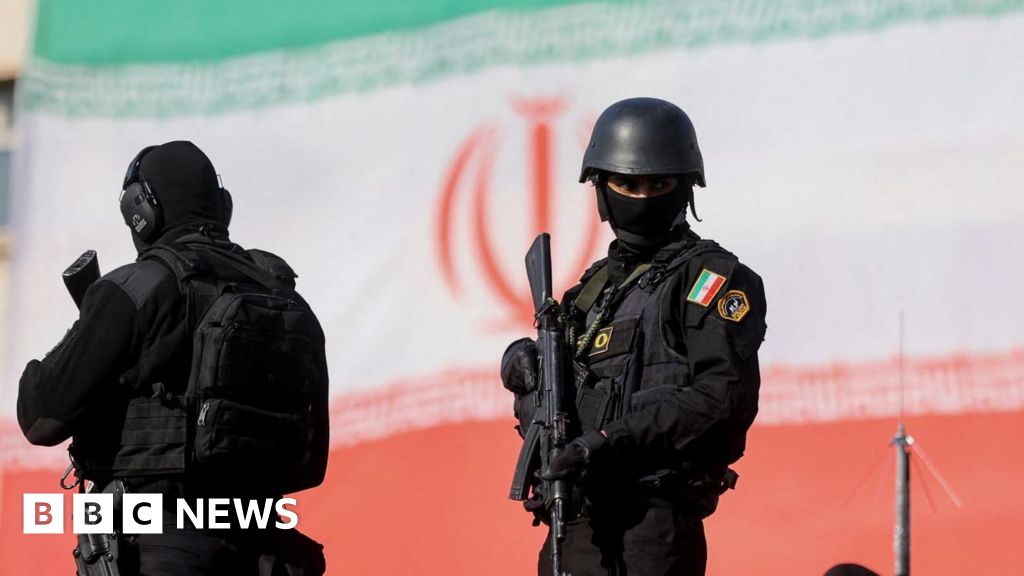
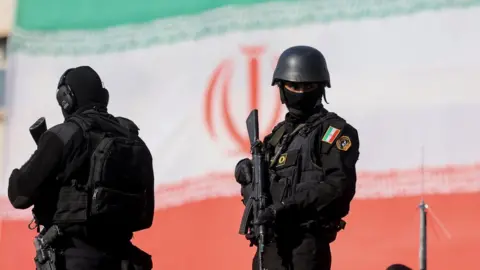
    Reuters Armed Iranian security personnel watch over a pro-government rally in Tehran, Iran (12 January 2026)Reuters

    Armed security forces were deployed at a pro-government rally in Tehran on Monday

    More than 2,000 people have been killed during the violent crackdown by security forces on protests in Iran, a human rights group has said, as President Trump promised Iranians that help was “on its way”.

    The US-based Human Rights Activists News Agency (HRANA) reported that it had so far confirmed the killing of 1,850 protesters, 135 people affiliated with the government and nine uninvolved civilians as well as nine children over the last 17 days despite an internet blackout.

    An Iranian official also told Reuters that 2,000 people had been killed but that “terrorists” were to blame.

    Trump said Iranian authorities would “pay a big price” for the killings and urged people to “keep protesting”.

    He has been weighing military and other options in response to the crackdown, having already announced 25% tariffs on any country trading with Iran.

    The protests, which have reportedly spread to 180 cities and towns in all 31 provinces, were sparked by anger over the collapse of the Iranian currency and soaring cost of living.

    They quickly widened into demands for political change and became one of the most serious challenges to the clerical establishment since the 1979 Islamic revolution.

    The protests escalated significantly last Thursday and were met with deadly force by authorities, masked by a near total shutdown of the internet and communication services.

    HRANA said on Tuesday afternoon that, as well as confirming the killing of at least 2,003 people during the unrest, it was also reviewing reports of another 779 deaths.

    “We’re horrified, but we still think the number is conservative,” Deputy Director Skylar Thompson told the Associated Press.

    Another group, Norway-based Iran Human Rights (IHR), meanwhile said it had confirmed the killing of at least 734 protesters.

    Its director, Mahmood Amiry-Moghaddam, told AFP news agency that the figures were “based on information received from fewer than half of the country’s provinces and fewer than 10% of Iran’s hospitals”, adding: “The real number of those killed is likely in the thousands.”

    Reuters said the unnamed Iranian official who put the death toll at about 2,000 had not given a breakdown of the figure. However, it added, he said “terrorists” were behind the deaths of both protesters and security personnel.

    Mortuary videos shows violent government crackdown in Iran

    It is difficult to gauge the true scale of bloodshed because, like other international news organisations, the BBC is not able to report from inside the country.

    However, videos posted online on Sunday showed people searching for the bodies of their loved ones at the Kahrizak Forensic Centre in Tehran. The BBC counted at least 180 shrouded bodies and body bags in the footage.

    Around 50 bodies were visible in another video from the facility shared on Monday.

    “My friend went there [Kahrizak] to look for his brother, and he forgot his own sorrow,” an activist told BBC Persian on Monday.

    “They piled up bodies from every neighbourhood, like Saadatabad, Naziabad, Sattarkhan. So you go to your address pile and search there. You don’t know a fraction of the level of violence that’s been used.”

    Hospitals in the capital have also reportedly been overwhelmed by the number of casualties.

    Prof Shahram Kordasti, an Iranian oncologist based in London, told the BBC’s Newsday programme on Tuesday that the last message he had received from a colleague in Tehran said: “In most hospitals, it’s like a warzone. We are short of supplies, short of blood.”

    Other doctors at “two to three hospitals” had also said they had treated hundreds of injured or dead people, he added.

    An Iranian living in Rasht, near the Caspian Sea coast, described the city as unrecognisable. “Everywhere is burnt with fire,” they said.
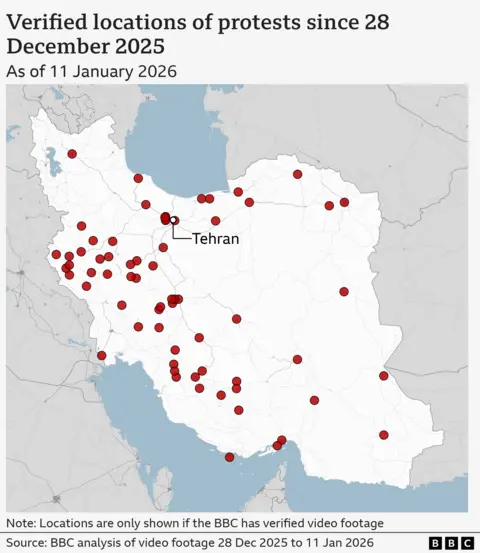
    Map showing verified locations of protests in Iran since 28 December 2025, as of 11 January 2026

    Not long after HRANA released its latest death toll, President Trump wrote on Truth Social: “Iranian Patriots, KEEP PROTESTING – TAKE OVER YOUR INSTITUTIONS!!! Save the names of the killers and abusers. They will pay a big price.”

    “I have cancelled all meetings with Iranian Officials until the senseless killing of protesters STOPS. HELP IS ON ITS WAY. MIGA!!!,” he added, using the acronym for a US-based Iranian opposition slogan, “Make Iran Great Again”.

    Trump’s national security team was expected to hold a meeting at the White House on Tuesday to discuss options for Iran.

    On Monday night, US defence officials told the BBC’s US partner, CBS news, that Trump had been briefed on a wide range of covert and military tools, including long-range missile strikes, cyber operations and psychological campaign responses.

    At the same time, Iranian Foreign Minister Abbas Araghchi told Al Jazeera that Iran was ready for diplomacy but also for other options, including “if the US wanted to test the military option which it had tested in the past”. In June, the US carried out air strikes on key Iranian nuclear facilities during a 12-day war between Iran and Israel.

    Araghchi also said that Iranian government had been in dialogue with protesters, but that it had been forced to take action after “trained terrorist groups” run from abroad infiltrated the demonstrations and targeted security forces.

    His comments echoed those of the Supreme Leader, Ayatollah Ali Khamenei, who told supporters at state-organised rallies across the country on Monday that they had “neutralised the plans by foreign enemies that were meant to be performed by domestic mercenaries”.
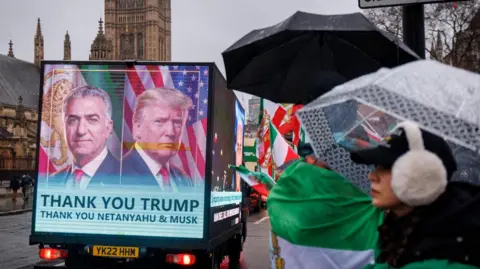
    EPA A mobile billboard saying "Thank you Trump" passes by supporters of Reza Pahlavi, the exiled son of Iran's last shah, protesting outside the Houses of Parliament in London on 13 January 2026EPA

    Supporters of Reza Pahlavi, the exiled son of Iran’s last shah, protested outside the Houses of Parliament in London on Tuesday

    Also on Tuesday, UK Foreign Secretary Yvette Cooper summoned the Iranian ambassador to protest in response at what she called “the horrendous and brutal killing of Iranian protesters”.

    The UN human rights chief Volker Türk urged Iranian authorities to halt all forms of violence and repression against peaceful protesters immediately, his office said.

    He added that the labelling of protesters as “terrorists” to justify violence was unacceptable and that it was “extremely worrying” to see statements from Iranian officials indicating the possibility of the death penalty being used against protesters through expedited trials.

    Judiciary chief Gholamhossein Mohseni Ejei said on Monday that those involved in the unrest would be “dealt with seriously and severely”. And prosecutors have said some will be charged with “enmity against God”, a national security offence that carries the death penalty.

    More than 16,780 protesters have been arrested during the unrest, according to HRANA.

    A 26-year-old man detained last Thursday has already been sentenced to death, according to his family and Norway-based Kurdish human rights group Hengaw.

    A relative of Erfan Soltani’s family told BBC Persian that “in an extremely rapid process, within just two days, the court issued a death sentence, and the family was told that he is due to be executed [this] Wednesday”.

    “We have never witnessed a case move so quickly,” Awyar Shekhi of Hengaw told the BBC. “The government is using every tactic they know to suppress people and spread fear.”

    Speaking to the BBC’s US news partner CBS later on Tuesday, Trump said the US would take “very strong action” if Iran’s authorities started hanging protesters.

    “If they hang them, you’re going to see some things… We will take very strong action if they do such a thing,” he said.

    BBC Persian Screengrab of recent video showing a crowd of protesters in Tabriz, western IranBBC Persian

    Videos obtained by BBC Persian showed recent protests in Tabriz and several other cities in western Iran

    Türk also demanded that Iranian authorities restore full access to the internet and other communication services.

    Some international calls from Iran went through on Tuesday, but the internet shutdown has now passed 120 hours, according to monitor NetBlocks.

    One person living near Tehran with access via the Starlink satellite service told BBC Persian that there were “checkpoints in every block”, where cars and the phones of their occupants were being inspected by security forces.

    New videos of protests in recent days have also emerged, with BBC Persian verifying those filmed in the central city of Arak and the western cities of Tabriz, Urmia and Khorramabad.

    In the footage from Khorramabad, gunfire can be heard during clashes between security forces and protesters, some of whom are throwing stones.

    The protesters chant slogans “Death to the dictator” – a reference to Ayatollah Khamenei – and “Reza Shah, may your soul rest in peace” – referring to the late monarch Mohammad Reza Pahlavi, who was overthrown in the 1979 revolution and whose son Reza lives in exile.



    Source link

  • Long-Running Web Skimming Campaign Steals Credit Cards From Online Checkout Pages

    Long-Running Web Skimming Campaign Steals Credit Cards From Online Checkout Pages


    Jan 13, 2026Ravie Lakshmanan Web Security / Data Theft

    Cybersecurity researchers have discovered a major web skimming campaign that has been active since January 2022, targeting several major payment networks like American Express, Diners Club, Discover, JCB Co., Ltd., Mastercard, and UnionPay.

    “Enterprise organizations that are clients of these payment providers are the most likely to be impacted,” Silent Push said in a report published today.

    Digital skimming attacks refer to a category of client-side attacks in which bad actors compromise legitimate e-commerce sites and payment portals to inject malicious JavaScript code that’s capable of stealthily harvesting credit card information and other personal information when unsuspecting users attempt to make a payment on checkout pages.

    These attacks are classified under an umbrella term called Magecart, which initially referred to a coalition of cybercriminal groups that targeted e-commerce sites using the Magento software, before diversifying to other products and platforms.

    Cybersecurity

    Silent Push said it discovered the campaign after analyzing a suspicious domain linked to a now-sanctioned bulletproof hosting provider Stark Industries (and its parent company PQ.Hosting), which has since rebranded to THE[.]Hosting, under the control of the Dutch entity WorkTitans B.V., is a sanctions evasion measure.

    The domain in question, cdn-cookie[.]com, has been found to host highly obfuscated JavaScript payloads (e.g., “recorder.js” or “tab-gtm.js”) that are loaded by web shops to facilitate credit card skimming.

    The skimmer comes with features to evade detection by site administrators. Specifically, it checks the Document Object Model (DOM) tree for an element named “wpadminbar,” a reference to a toolbar that appears in WordPress websites when logged-in administrators or users with appropriate permissions are viewing the site.

    In the event the “wpadminbar” element is present, the skimmer initiates a self-destruct sequence and removes its own presence from the web page. An attempt to execute the skimmer is made every time the web page’s DOM is modified, a standard behavior that occurs when users interact with the page.

    That’s not all. The skimmer also checks to see if Stripe was selected as a payment option, and if so, there exists an element called “wc_cart_hash” in the browser’s localStorage, which it creates and sets to “true” to indicate that the victim has already been successfully skimmed.

    The absence of this flag causes the skimmer to render a fake Stripe payment form that replaces the legitimate form through user interface manipulations, thereby tricking the victims into entering their credit card numbers, along with the expiration dates and Card Verification Code (CVC) numbers.

    “As the victim entered their credit card details into a fake form instead of the real Stripe payment form, which was initially hidden by the skimmer when they initially filled it out, the payment page will display an error,” Silent Push said. “This makes it appear as if the victim had simply entered their payment details incorrectly.”

    Cybersecurity

    The data stolen by the skimmer extends beyond payment details to include names, phone numbers, email addresses, and shipping addresses. The information is eventually exfiltrated by means of an HTTP POST request to the server “lasorie[.]com.”

    Once the data transmission is complete, the skimmer erases traces of itself from the checkout page, removing the fake payment form that was created and restoring the legitimate Stripe input form. It then sets “wc_cart_hash” to “true” to prevent the skimmer from being run a second time on the same victim.

    “This attacker has advanced knowledge of WordPress’s inner workings and integrates even lesser-known features into their attack chain,” Silent Push said.


    Source link

  • Authoritarian regimes die gradually then suddenly, but Iran is not there yet

    Authoritarian regimes die gradually then suddenly, but Iran is not there yet


    Jeremy BowenInternational editor

    Mortuary videos shows violent government crackdown in Iran

    How does an authoritarian regime die? As Ernest Hemingway famously said about going broke – gradually then suddenly.

    The protesters in Iran and their supporters abroad were hoping that the Islamic regime in Tehran was at the suddenly stage. The signs are, if it is dying, it is still at gradual.

    The last two weeks of unrest add up to a big crisis for the regime. Iranian anger and frustration have exploded into the streets before, but the latest explosion comes on top of all the military blows inflicted on Iran in the last two years by the US and Israel.

    But more significant for hard-pressed Iranians struggling to feed their families has been the impact of sanctions.

    In the latest blow for the Iranian economy, all the UN sanctions lifted under the now dead 2015 nuclear deal were reimposed by the UK, Germany and France in September. In 2025 food price inflation was more than 70%. The currency, the rial, reached a record low in December.

    While the Iranian regime is under huge pressure, the evidence is that it’s not about to die.

    Crucially, the security forces remain loyal. Since the Islamic revolution in 1979 the Iranian authorities have spent time and money creating an elaborate and ruthless network of coercion and repression.

    In the last two weeks, the regime’s forces obeyed orders to shoot their fellow citizens in the streets. The result is that the demonstrations of the last few weeks have ended – as far as we can tell in a country whose rulers continue to impose a communications black out.

    At the forefront of the suppression of protest is the Iranian Revolutionary Guards Corps (IRGC), the most important single organisation in the country.

    It has the specific task of defending the ideology and system of government of the Islamic revolution of 1979, answering directly to the supreme leader, Ayatollah Ali Khamenei. The IRGC is estimated to have something like 150,000 men under arms, operating as a parallel force to Iran’s conventional armed military. It is also a major player in the Iranian economy.

    A potent mix of power, money, corruption and ideology means it has every reason to defend the system.

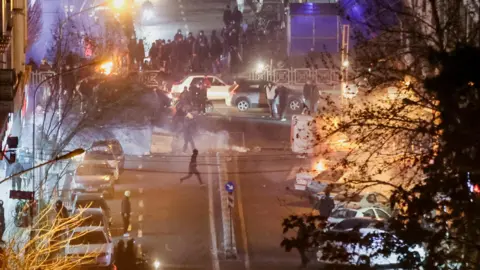
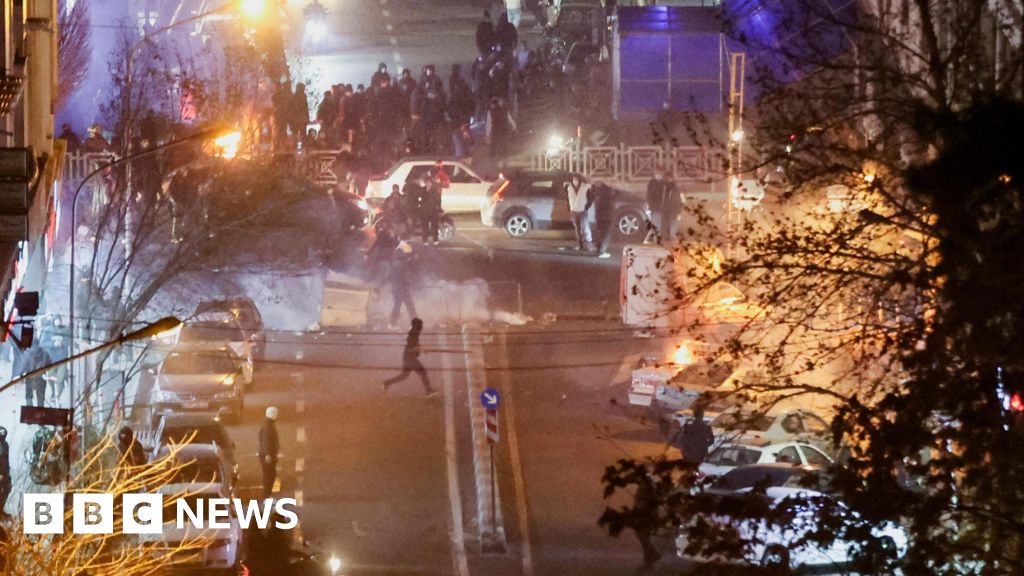
    West Asia News Agency via Reuters A street scene at night showing protesters gathering around parked cars. Smoke can be seen and there are some fires near the crowd.West Asia News Agency via Reuters

    Iran’s judiciary chief has vowed “swift and harsh” punishment for “rioters”

    The IRGC has an auxiliary force, the Basij militia, a volunteer paramilitary organisation. It claims to have millions of members. Some western estimates put its active duty contingent in the hundreds of thousands, still a very substantial total. The Basij are at the sharp end of the regime’s crackdowns against protesters.

    I saw the IRGC and the Basij in action in Tehran in 2009, as they moved to suppress huge demonstrations that followed a disputed presidential election. Basij volunteers lined the streets armed with rubber truncheons and wooden clubs.

    Behind them were uniformed men with automatic weapons. Motorcycle squads roared around Tehran’s broad avenues, descending on groups trying to protest. In less than two weeks, protests that had choked the streets were reduced to small groups of students chanting slogans and setting fire to rubbish skips.

    At dusk, people went to their balconies and rooftops to chant God is greatest, as their parents had against the Shah, until that petered out too.

    The seeming resilience of the internal security forces does not mean that the supreme leader or his lieutenants can or will relax. US President Donald Trump is still threatening to take action. The millions of Iranians who want the fall of the regime must be seething with resentment and anger.

    In Tehran, the government and the supreme leader appear to be looking for ways to release some of the pressure they are facing. Bellicose official rhetoric is mixed with an offer to resume negotiations with the US.

    It is hard to see how the two sides can make a deal over Iran’s nuclear plans and ballistic missile programme that have defeated earlier rounds of talks. But negotiations could buy time for Iran, especially if Trump can be convinced that a deal, however unlikely, is possible.

    As part of his pressure campaign, Trump says that he will slap a 25% tariff on the goods of any country that does business with Iran. Again, it is hard to see how that might work. China buys most of Iran’s oil.

    Trump and China’s President Xi Jinping agreed a truce in their trade war last autumn, with a summit due to be held in Beijing in April. The summit will deal the biggest issues facing the world’s two superpowers. Would Trump want to jeopardise or disrupt the summit simply to keep up pressure on Iran?

    In Tehran the biggest priority for the ageing Supreme Leader Ayatollah Khamenei is to preserve the Islamic Republic’s system of rule. More eruptions of protest can expect a severe response.

    An advantage for the regime is lack of coherent leadership among protesters. The eldest son of the Shah deposed by the revolution almost half a century ago has been trying to be the leader they lack. His appeal seems to be limited by his family’s history and his close links with Israel.

    One lesson that might worry the clerics and military men in Tehran comes from their erstwhile ally, former President Bashar al-Assad of Syria. He seemed to have won his war, and was being slowly rehabilitated by Saudi Arabia and the Arab League when he was faced at the end of 2024 with a well organised rebel offensive.

    Both Russia and Iran, his two most important allies were neither willing or perhaps able to save him. Within days, Assad and his family were flying into exile in Moscow.

    An authoritarian regime decays gradually, then suddenly. When Assad’s Syria collapsed, it went very fast. Another example that might be studied in Tehran is the downfall in 2011 of President Ben Ali of Tunisia, when the army moved to protect protesters from the internal security forces.

    The fall of Ben Ali precipitated the resignation of Hosni Mubarak of Egypt. He might have survived huge demonstrations had not the armed forces decided that to save their own position he had to go.

    Could that happen in Iran? Perhaps. Not yet.

    Opponents of the Islamic regime will hope for more pressure at home and abroad and the emergence of credible leadership, so that the process of decay will speed up, accelerating from gradual, to sudden.


    Source link